
The short answer
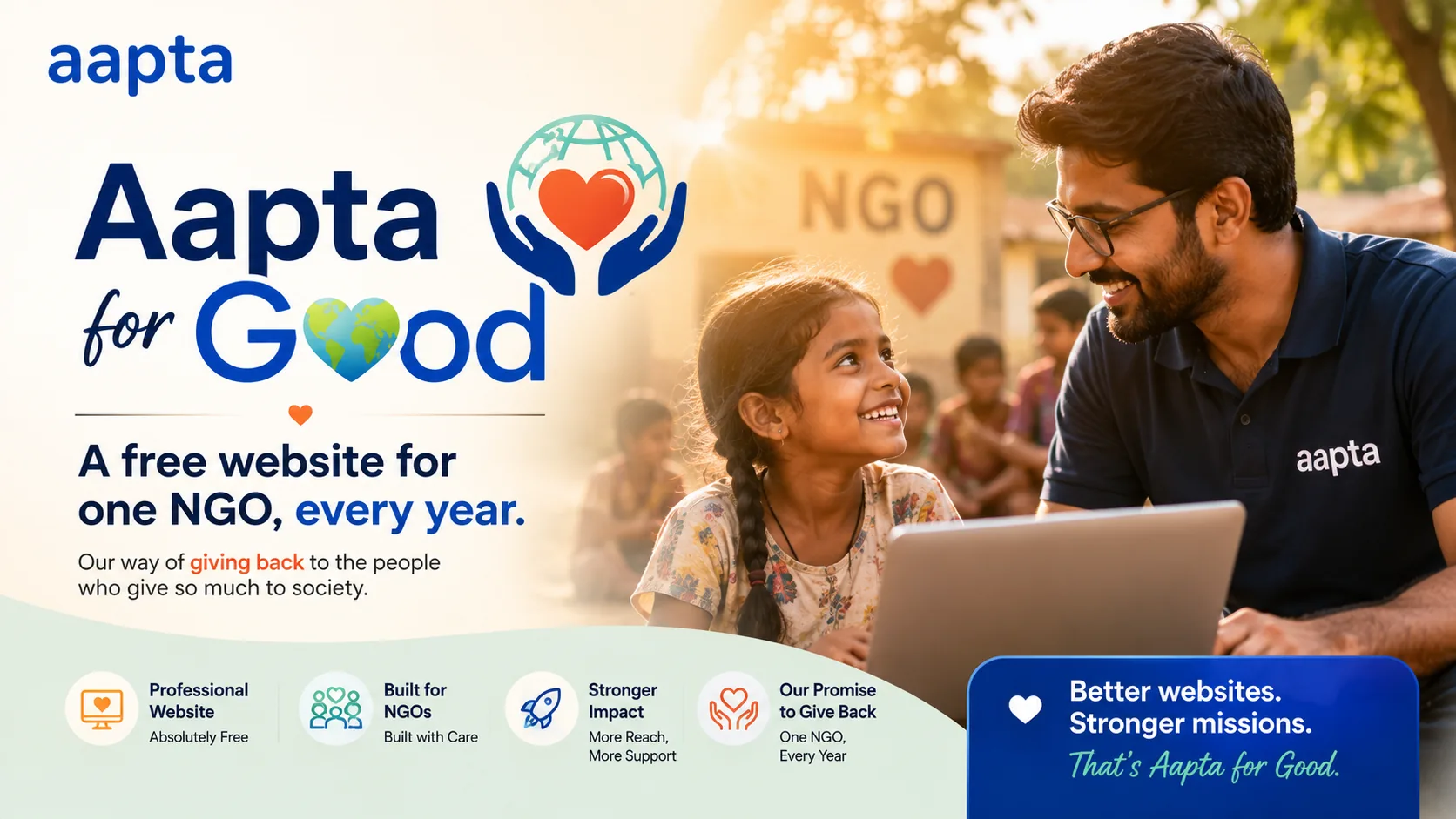
Aapta for Good is our give-back programme: every year, we give one NGO a completely free website. It is open to any registered NGO or non-profit, in any country, working on any cause. Aapta covers everything that usually costs money, the design, the development, the ongoing maintenance, the security, and the payment or donation integrations. The NGO pays only for the modest running costs we cannot absorb: hosting, email, and a domain, which you can buy from us or from anywhere else. We take on one project a year so we can give it our full attention. To apply, fill in the form on the Aapta for Good page with your details, your registration certificate, and your NGO profile. We read every application ourselves and reach out to the NGO we choose. This post explains why we are doing it, who can apply, and how it works.
Why we are doing this
We have built on the web since 2007. Over nineteen years, the web has given our business a livelihood, a craft, and a community. Aapta for Good is a small, deliberate way of giving some of that back.
The specific gap we want to close is this: a lot of NGOs doing genuinely important work do not have a proper website, and cannot easily afford one, or the team to keep it maintained and secure. That is not a cosmetic problem anymore. In 2026 a website is often the thing that unlocks trust and funding.
Consider what the data says about non-profits and websites. In the United States, about 91% of non-profits now have a website, which means roughly 9% still do not, per 2026 non-profit sector statistics. In many other parts of the world, and especially among small, local, grassroots organisations, that gap is far wider. And the cost of being without a site keeps rising: grant-makers and institutional funders increasingly require online verification before they will consider an organisation, and a professional website has quietly become as expected as transparent accounts. No website often means no trust, and no trust makes funding hard to secure, as analysis of non-profit digital presence makes clear.
There is a credibility dimension too. Around 75% of people judge an organisation's credibility on the design of its website, per research on why small NGOs need a strong digital presence, and that judgement applies to a charity exactly as it does to a business. An NGO with an outdated or missing site is fighting an uphill battle for donations, volunteers, and partnerships before anyone reads a word about the work.
So the maths is simple and a little unfair. The organisations that most need visibility and trust are often the ones least able to pay for the website that would give it to them. Aapta for Good exists to fix that for one organisation a year, properly and for the long term.
What Aapta covers
The whole point is that the expensive, technical, ongoing parts are on us. For the NGO we take on, we handle:
- Website design and development, built to your cause and your audience, not a generic template.
- Ongoing maintenance and updates, so the site stays current and does not rot.
- Security, backups and monitoring, the same care we give paying clients.
- Payment and donation integrations, so you can actually collect donations online.
- Contact, volunteer and enquiry forms, wired up properly.
- A mobile-friendly, fast, accessible build, because most of your visitors are on a phone.
- Basic SEO and analytics setup, so people can find you and you can see what is working.
- A handover walkthrough for your team, so you can update content yourselves.
This is not a stripped-down charity build. It is a real website, made and looked after the way we make and look after any website.
What the NGO pays for
We are honest about the one thing we cannot make free. A website needs three running services that are billed by third parties, and we cannot absorb those indefinitely for you:
| Cost | What it is | Notes |
|---|---|---|
| Hosting | The server your website runs on | Buy a plan from us, or bring your own |
| Professional inboxes on your domain | e.g. [email protected] | |
| Domain | Your web address | e.g. yourngo.org, renewed yearly |
These are modest, they are ongoing, and you are completely free to buy them wherever you like. If you buy hosting and email from us we will set everything up for you, but there is no obligation, and choosing an outside provider does not affect your application in any way. Everything else, the parts that usually run into real money, is covered.
Who can apply
We have kept eligibility as open as we honestly can:
- Any registered NGO or non-profit. The one firm requirement is a valid registration certificate, so we can confirm you are a genuine organisation.
- Any country. There is no geographic restriction. We work with clients across India, the United States, and the United Kingdom, and this programme is open worldwide.
- Any cause. Education, health, environment, animal welfare, women and children, rural development, arts, whatever your mission is.
- With or without an existing website. Whether you have nothing, or a dated site that needs replacing, you are welcome to apply.
We give this back to society because we believe good work deserves a good home on the web, and we do not want the cost of a website to be the reason important work stays invisible.
How the programme works
Because we offer one project a year, we choose with care and then commit fully. The path from application to a live website:
- You apply. Fill in the short form on the Aapta for Good page with your name, contact details, registration certificate, and a profile of your NGO. If you already have a website or a domain, you can share that too.
- We review. We read every application ourselves. We look at what you do, who you serve, and what a website would change for you.
- We reach out. We contact the NGO we select to understand the project properly and plan the build together.
- We build and maintain it. We design, develop and launch your website, and then keep maintaining and securing it going forward, the way we do for any site in our care.
We cannot take on every organisation, and we will not pretend otherwise. But every application is read, and the one we choose gets the full weight of what we do.
How you can help even if you are not an NGO
If you are reading this and you are not a non-profit, you can still make this count. The single most useful thing you can do is tell an NGO who deserves it. Most small organisations doing quiet, important work will never hear about a programme like this on their own. A forwarded link from someone who knows their work is often how the right application reaches us. Share the Aapta for Good page, or point them to this post.
Where this leaves you
Aapta for Good is one website a year, given fully and maintained for the long term, to one NGO doing work that deserves to be seen. It is a small programme by design, because we would rather do one build properly than a dozen badly. If you run an NGO, or you know one, the application is open now. And if you want to understand why a website matters so much in the current search and AI landscape, our piece on whether businesses still need a website in 2026 applies just as much to non-profits as to companies.
Apply for a free website on the Aapta for Good page.
FAQ
Is the website really free for the NGO?
Yes. Aapta covers the design, development, ongoing maintenance, security, and payment or donation integrations at no cost. The only things the NGO pays for are hosting, email, and a domain, which are third-party running costs we cannot absorb. You can buy those from us or from any provider you like.
Which NGOs are eligible for Aapta for Good?
Any registered NGO or non-profit, in any country, working on any cause, whether or not you already have a website. The one firm requirement is a valid registration certificate so we can confirm you are a genuine organisation.
How many NGOs do you help each year?
One. We deliberately take on a single project a year so we can give it our full attention and maintain it properly over time, rather than spreading ourselves thin across many rushed builds.
Do I have to buy hosting and email from Aapta?
No. You are free to buy hosting, email, and your domain from any provider. If you buy them from us we will set everything up for you, but choosing an outside provider does not affect your application at all.
What do I need to apply?
Your full name, email, and mobile number, a copy of your NGO's registration certificate, and a profile of your organisation (a PDF, PowerPoint, or Word document). There is also a message box to tell us about your work, and an optional field for any existing website or domain.
What happens after I apply?
We read every application ourselves. We review what your organisation does and what a website would change for you, then contact the NGO we select to plan the project. Because we take on one build a year, please allow us some time to respond.
Can I apply if my NGO already has a website?
Yes. Whether you have no website, or an outdated one that needs replacing, you are welcome to apply. Tell us about your current site in the application so we understand where you are starting from.
How can I support the programme if I am not an NGO?
Tell an NGO who deserves it. Forwarding the Aapta for Good page to a good organisation that would never otherwise hear about it is genuinely the most useful thing you can do, because the right application often reaches us through someone who knows the work.
About the author
Dharmendra Asimi is the founder of Aapta Solutions, established in 2007 and now serving SMBs and growing brands across India, the United States, and the United Kingdom. Over the past twenty years he has shipped WordPress builds, e-commerce stores, managed cloud hosting, and SEO programmes for hundreds of businesses (from single-product Shopify stores to multi-region WordPress estates handling Black Friday peaks).
He is the creator of Aapta GEO (a free 30-second AI-readiness scan) and Aapta SEO AI (a monthly tracker for how ChatGPT, Claude, Perplexity, and Gemini cite your content). His writing on web engineering and AI-search visibility is read by founders, marketing teams, and SEO managers across three time zones.
Areas of expertise: WordPress development at scale · managed cloud hosting (AWS, GCP, Azure, Cloudflare) · technical SEO · Generative Engine Optimization (GEO) · AI-search citation tracking · ecommerce architecture across WooCommerce, SureCart, Shopify, and Magento · Site Reliability Engineering for content platforms · brand strategy and visual identity.
Connect: LinkedIn · X · Instagram · personal site · About page · Contact Aapta
This article is maintained as part of Aapta's content quality programme. If any data point looks stale or incorrect next time you read this, tell us and we will verify and update within 48 hours.
Need help with this?
Our team has 19+ years of experience and can help you implement everything discussed in this article.
Book a Discovery Call