
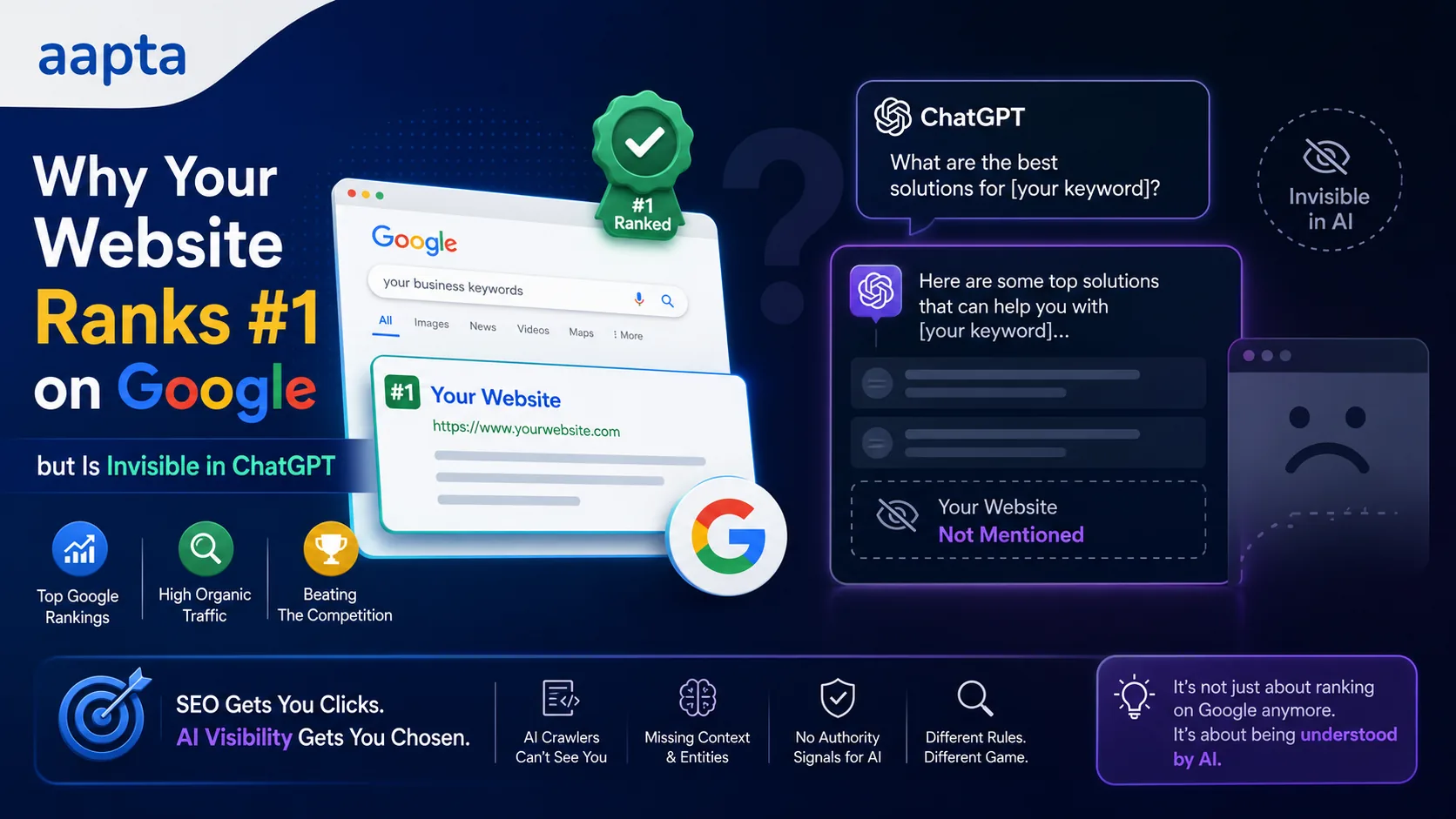
The short answer
Ranking #1 on Google no longer means an AI engine will cite you. In 2026 the overlap between the pages that rank at the top of Google and the sources that AI engines actually quote has collapsed from around 70% to under 20%, according to 5W Research. Ahrefs data puts it sharper still: only about 12% of the URLs cited inside AI answers also rank in Google's top 10 for the same prompt. The reason is simple. Google ranks pages by links, authority, and relevance to a keyword. AI engines assemble an answer by pulling small, quotable chunks from sources they can read cleanly, trust as entities, and verify as fresh, and ChatGPT in particular leans on Bing and its own index rather than Google at all. So a page can be perfect for Google and still be unreadable, unquotable, or unknown to ChatGPT. This guide explains exactly why the two systems diverge, which engines still respect Google rank, and the step-by-step fix to earn AI citations even for pages you already rank with.
The moment every business owner is having in 2026
Here is the scene I hear about on calls almost weekly. A business owner has done the work. They rank #1 on Google for their main service and city. They have spent money on SEO and it shows in Search Console. Then, out of curiosity, they open ChatGPT and ask the exact question their page answers so well: "who is the best [their service] in [their city]?" Their business is not in the answer. A competitor they have barely heard of is named instead, in a confident paragraph, with a tidy citation.
The first reaction is usually that something is broken. It is not. This is the single biggest structural shift in search right now, and it is happening quietly because Google rankings still look healthy while the traffic those rankings used to send keeps shrinking. Over 60% of searches now carry an AI-generated component, per industry GEO analysis for 2026, and AI-referred visitors convert at far higher rates than a cold organic click. The visibility is moving. Many businesses have not noticed because they are still watching the old scoreboard.
What the 2026 data actually shows
This is not a hunch. Several independent studies in 2026 measured how often top Google results show up as AI citations, and the numbers all point the same way.
| Finding | Figure | Source |
|---|---|---|
| Overlap between top Google rankings and AI-cited sources | Fell from ~70% to under 20% | 5W Research, 2026 |
| AI-cited URLs that also rank in Google's top 10 | ~12% | Ahrefs, 2026 |
| ChatGPT citations that come from Google's top 10 | ~30% (70% rank nowhere in Google or Bing top 10) | Leapd, 2026 |
| Google AI Mode citations drawn from Google's own top 10 | ~93% | Leapd, 2026 |
| Perplexity citations drawn from Google's top 10 | ~89% | Leapd, 2026 |
| Domain overlap between ChatGPT and Perplexity citations | ~11% | AuthorityTech, 2026 |
Read the table and a clear picture forms. Some AI engines still lean heavily on Google rankings, and some barely touch them. Google's own AI Overviews and AI Mode pull most of their citations from Google's top 10, which makes sense because they are Google. Perplexity also respects Google rank closely. But ChatGPT, the engine most people actually use, sources roughly 70% of what it recommends from pages that rank in neither Google's nor Bing's top 10. And the engines barely agree with each other: only about 11% of domains cited by ChatGPT are also cited by Perplexity.
The takeaway is uncomfortable but freeing. There is no single ranking you can win to guarantee AI visibility. Being #1 on Google helps you with Perplexity and Google's own AI surfaces, and does almost nothing for you in ChatGPT.
Why Google rank and AI citation reward different things
To fix the problem you have to understand that these are two different machines solving two different problems.
Google is a ranking engine. It takes a query, scores every candidate page on hundreds of signals (backlinks, authority, relevance, page experience), and returns a ranked list of ten links. Its job is to point you at the best page. Your page is the destination.
An AI engine is an answering engine. It takes a question, decides which handful of sources to consult, fetches a small number of them, reads them, extracts the most relevant sentences, and writes a single synthesised answer with citations. Your page is not the destination. It is raw material the model chews up to build its own answer. We broke the full retrieval pipeline down in our 2026 ChatGPT SEO field guide, but the short version is that being a great destination and being great raw material are not the same thing.
Three consequences fall out of that difference.
First, structure beats authority at the margin. Google can reward a page that is authoritative even if it is a wall of prose. An AI engine needs to lift a clean, self-contained chunk out of your page. If your answer is buried in paragraph nine, wrapped in qualifiers, or split across three sections, the model often cannot extract it cleanly and reaches for a competitor who stated it in one crisp sentence.
Second, the entity matters more than the page. Google ranks URLs. AI engines reason about entities, meaning who you are as a business. If the model cannot confidently connect your page to a known, verified business with consistent details across the web, it hesitates to cite you even when your page is relevant. We covered this entity-verification dynamic in the local maps SEO guide.
Third, freshness is weighted harder. AI engines favour recent content when choosing what to cite, because a stale answer is a wrong answer. A page that has ranked for three years on the strength of old backlinks can keep its Google position while quietly falling out of AI citations because its data reads as dated.
Which engines still respect your Google rank
Because the fix depends on which engines you care about, here is the honest breakdown for 2026.
- Google AI Overviews and AI Mode pull roughly 93% of citations from Google's top 10. If you rank well on Google, you are already most of the way there. Your job is mostly to make the ranked page extractable.
- Perplexity draws around 89% of its citations from content that ranks well on Google. Strong Google SEO carries over here better than anywhere else.
- Gemini sits in the Google ecosystem and leans on Google's crawlers and Knowledge Graph, so entity consistency and Google visibility both help.
- ChatGPT is the outlier and the one that matters most by usage. Its real-time pipeline is Bing-dependent, supplemented by OpenAI's own index, and roughly 70% of what it cites ranks nowhere in Google's or Bing's top 10. Google rank barely helps you here. Brand mentions across the web, Bing visibility, and clean extractable content do.
- Claude pulls about 53% of citations from Google's top 10, landing between ChatGPT and Perplexity.
So "I rank #1 on Google" is a strong hand for Perplexity and Google's own AI, a medium hand for Claude, and close to a bluff for ChatGPT. That single fact explains why so many well-ranked businesses are invisible in the engine their customers use most.
How to fix it: earn AI citations even for pages you already rank with
The good news is that almost every fix is within your control and does not require you to sacrifice your Google rankings. You are adding a layer, not rebuilding. Here is the order I would work in.
1. Restructure your key pages for extraction
This is the highest-impact change and it costs nothing but effort. AI engines cite content they can lift cleanly. Rework your most important pages so the answer is impossible to miss.
- Put a direct answer to the page's core question in the first 40 to 60 words, before any preamble. This is the chunk the model grabs.
- Use question-shaped headings that mirror how people actually ask ("How much does X cost?" not "Pricing").
- Keep fact density high: a concrete number, date, or named source every 150 to 200 words. "We cleaned 400 hacked WordPress sites in 2025" is citable; "we have lots of experience" is not.
- Make each section self-contained, so a model can quote it without needing the rest of the page for context.
- Add a short FAQ block in plain question-and-answer format. These map directly to the sub-questions AI engines answer.
Our SEO, GEO, AEO and LLMO optimisation guide goes deep on the on-page structure, but even applying the first-40-words rule across your top ten pages moves the needle within weeks.
2. Make your business entity unmistakable
AI engines cite entities they can verify. Give them no room for doubt.
- Emit Organization and LocalBusiness schema with a stable
@id, consistent name, address, phone, founding year, andsameAslinks to your social profiles. Use the same@idacross every page so the whole site resolves to one entity. - Keep your name, address, and phone identical everywhere: your website, your Google Business Profile, your directory listings, your social profiles. Any drift weakens the entity.
- Publish a clear About page that states, in plain sentences, who you are, what category you are in, and where you operate. AI engines read this to place you.
3. Refresh the data on pages that read as stale
If a page ranks on old authority but has not been touched in two years, update it. Replace every statistic with the most recent figure, stamp a visible "last updated" date, and make sure your JSON-LD dateModified reflects it. Answer engines weigh recency heavily, and a refresh often restores citation frequency within two to three weeks.
4. Build brand presence off your own site
This is the part that unlocks ChatGPT, which does not care much about your Google rank but does care whether your brand shows up across the web. Every third-party mention, review, listicle, forum answer, or industry article that names your business becomes a place an AI engine might encounter and cite you, even when it never touches your own site. Getting listed in reputable directories, earning a mention in a roundup, and being active in relevant communities all feed this. Distribution, not just on-page work, is what moves ChatGPT.
5. Open the door to AI crawlers
None of the above matters if you are blocking the bots. Check your robots.txt and confirm you allow the crawlers that feed AI answers:
User-agent: GPTBot
Allow: /

User-agent: OAI-SearchBot
Allow: /

User-agent: ChatGPT-User
Allow: /

User-agent: PerplexityBot
Allow: /

User-agent: ClaudeBot
Allow: /

User-agent: Google-Extended
Allow: /
Many "SEO-optimised" themes and security plugins block one or two of these by default, quietly cutting you out of the engines. While you are at it, add your site to Bing Webmaster Tools. Bing powers ChatGPT's real-time retrieval, so Bing visibility is one of the cheapest ways to improve ChatGPT citations, and most businesses have never set it up.
6. Measure it, because you cannot improve what you cannot see
Google Search Console will not tell you whether ChatGPT recommends you. You need to track AI citations directly: ask each engine your core questions on a schedule and record whether your brand appears. This is exactly what Aapta SEO AI does, running your key questions across ChatGPT, Claude, Perplexity, and Gemini every month and showing you where you are cited and where a competitor took the slot. Without measurement you are guessing.
How to check if you are invisible in AI right now
Before you fix anything, find out how bad it is. Two quick methods.
The manual check (ten minutes). Open ChatGPT, Perplexity, and Gemini. Ask each one the three or four questions a customer would ask before buying what you sell. Note whether your business is named, whether your site is cited, and who gets recommended instead. Do it in a logged-out or incognito session so your own history does not skew the result. If you are absent from ChatGPT while a competitor is present, you now know the gap.
The automated check (30 seconds). Run your homepage through Aapta GEO, our free AI-readiness scan. It grades how extractable your content is, whether your schema and entity signals are in place, and whether the AI crawlers can reach you, then flags the specific issues holding back your citations. It is the fastest way to turn "I feel invisible" into a concrete to-do list.
Google SEO signals vs AI citation signals, side by side
To make the mental model stick, here is what each system rewards.
| Signal | Weight for Google rank | Weight for AI citation |
|---|---|---|
| Backlinks and domain authority | Very high | Moderate (helps trust, not decisive) |
| Keyword relevance | High | Moderate |
| Extractable, chunked content | Low | Very high |
| Direct answer near the top | Low | Very high |
| Entity clarity + schema | Moderate | Very high |
| Freshness / recency | Moderate | High |
| Brand mentions across the web | Low | High (decisive for ChatGPT) |
| Bing visibility | None | High (for ChatGPT) |
| AI crawler access (robots.txt) | None | Mandatory |
The two columns overlap, but they are clearly not the same job. A business that only plays the left column can dominate Google and vanish from AI. A business that adds the right column keeps its Google rankings and starts showing up where the answers are now being given.
Where this leaves you
Ranking #1 on Google is still worth having. It feeds Perplexity, it feeds Google's own AI surfaces, and it still sends real clicks. But in 2026 it is no longer the finish line. The businesses winning the next few years are the ones treating Google rank and AI citation as two connected but separate goals, and doing the extra layer of work that earns both. Start by finding your gap, restructure your top pages for extraction, tighten your entity signals, open the door to the crawlers, and measure your citations so you can see progress. If your traffic has gone flat while your rankings held, this is almost certainly the reason, and it is fixable.
For the wider strategy behind all of this, our Generative Engine Optimization guide for 2026 is the companion piece, and if you have wondered whether a website even matters in the AI and social era, we answered that in do you still need a website in 2026. When you want a hand auditing and fixing your own site, talk to us.
FAQ
Why does my website rank #1 on Google but not appear in ChatGPT?
Because Google rank and AI citation reward different things. Google ranks pages by authority and relevance; ChatGPT builds answers from sources it can read cleanly, trust as an entity, and verify as fresh, and it relies on Bing and its own index rather than Google. In 2026, roughly 70% of ChatGPT's cited sources rank in neither Google's nor Bing's top 10. So a page can be perfect for Google and still be unquotable or unknown to ChatGPT.
Does ranking on Google help with any AI engines?
Yes, with some. Google's own AI Overviews and AI Mode pull about 93% of citations from Google's top 10, and Perplexity around 89%. Claude sits near 53%. ChatGPT is the outlier at roughly 30%, which is why strong Google rankings often fail to translate into ChatGPT visibility.
How much has the overlap between Google rankings and AI citations actually dropped?
According to 5W Research in 2026, the overlap between top Google rankings and AI-cited sources fell from around 70% to under 20%. Ahrefs found that only about 12% of AI-cited URLs rank in Google's top 10 for the same prompt. The trend is still moving downward.
What is the single most effective fix?
Restructuring your key pages for extraction. Put a direct answer to the page's main question in the first 40 to 60 words, use question-shaped headings, keep fact density high with concrete numbers and named sources, and add a plain FAQ block. AI engines cite content they can lift cleanly, and most business pages bury the answer too deep to be quoted.
How do I get cited by ChatGPT specifically?
ChatGPT cares less about your Google rank and more about brand presence across the web and Bing visibility. Earn third-party mentions in directories, roundups, and communities, add your site to Bing Webmaster Tools, make sure your robots.txt allows GPTBot, OAI-SearchBot, and ChatGPT-User, and structure your content for clean extraction.
Will fixing for AI hurt my Google rankings?
No. Everything that helps AI citation, clearer structure, direct answers, strong schema, fresh data, faster pages, also helps or is neutral for Google. You are adding a layer, not trading one for the other.
How do I know if AI engines are recommending me?
Google Search Console does not report this, so you have to check directly. Manually, ask ChatGPT, Perplexity, and Gemini your core buying questions in an incognito session and see who they name. For ongoing tracking, a tool like Aapta SEO AI runs your questions across the major engines monthly and shows where you are cited and where you are being beaten.
How long does it take to start showing up in AI answers after making changes?
On-page changes like restructuring and schema often show up in AI citations within two to three weeks, especially where an engine re-crawls frequently. Brand-presence work off your own site compounds more slowly, over one to three months, because it depends on new third-party pages being published and indexed.
About the author
Dharmendra Asimi is the founder of Aapta Solutions, established in 2007 and now serving SMBs and growing brands across India, the United States, and the United Kingdom. Over the past twenty years he has shipped WordPress builds, e-commerce stores, managed cloud hosting, and SEO programmes for hundreds of businesses (from single-product Shopify stores to multi-region WordPress estates handling Black Friday peaks).
He is the creator of Aapta GEO (a free 30-second AI-readiness scan) and Aapta SEO AI (a monthly tracker for how ChatGPT, Claude, Perplexity, and Gemini cite your content). His writing on web engineering and AI-search visibility is read by founders, marketing teams, and SEO managers across three time zones.
Areas of expertise: WordPress development at scale · managed cloud hosting (AWS, GCP, Azure, Cloudflare) · technical SEO · Generative Engine Optimization (GEO) · AI-search citation tracking · ecommerce architecture across WooCommerce, SureCart, Shopify, and Magento · Site Reliability Engineering for content platforms · brand strategy and visual identity.
Connect: LinkedIn · X · Instagram · personal site · About page · Contact Aapta
This article is maintained as part of Aapta's content quality programme. If any data point looks stale or incorrect next time you read this, tell us and we will verify and update within 48 hours.
Need help with this?
Our team has 19+ years of experience and can help you implement everything discussed in this article.
Book a Discovery Call