
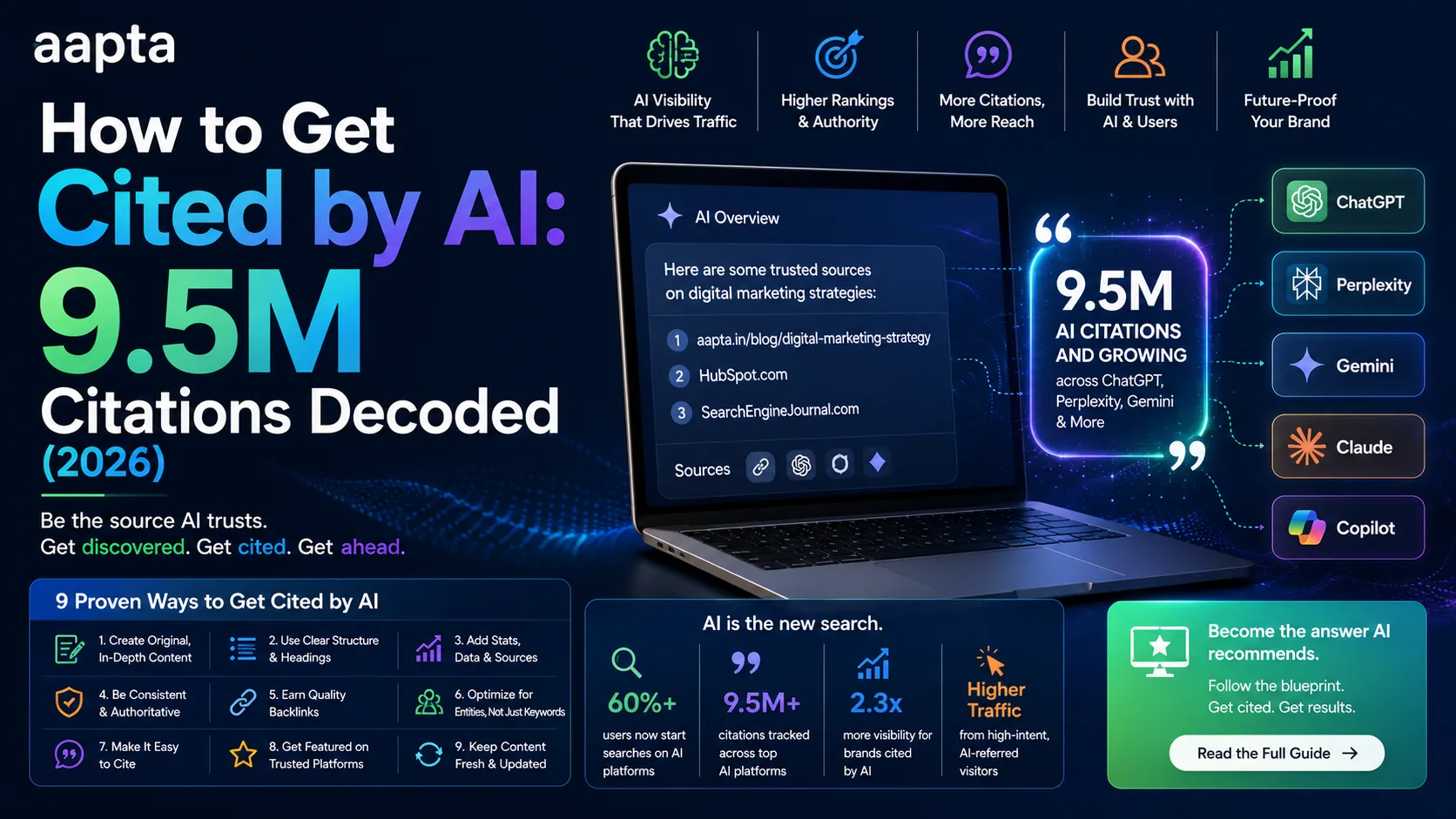
The short answer
B2B buyers have shifted from searching to asking. In 2026, 94% of B2B buyers use AI in their purchase research, and 51% now start a software search with an AI chatbot more often than with Google, up from 29% a year earlier (G2, 2026). AI tools return one synthesised answer instead of ten blue links, so visibility is no longer about ranking. It is about being cited inside that answer. Meltwater analysed 9.5 million AI citations across six major models and 14 B2B categories, and found LinkedIn is the second most-cited source of all, behind only YouTube (Meltwater, May 2026). The pattern behind the winning content is unusually clear: individual experts, not brand pages, writing structured, data-rich, recent posts. Seventy-five percent of LinkedIn's citations came from personal profiles, every single top-cited article used bullet or numbered lists, and 48% of cited content was published within the previous three months. This guide breaks down every number, sets it against the wider AI-citation research, and turns it into a plan to get your business cited.
The shift: buyers ask AI now, they do not search
Before the LinkedIn finding matters, you have to accept what changed underneath it. Search did not just get an AI feature bolted on. The starting point of the buyer journey moved.
The numbers are not subtle:
- 51% of B2B software buyers now begin research with an AI chatbot more often than with Google, up from 29% in April 2025 (G2, 2026). That is a near-doubling in twelve months.
- 73% of B2B buyers use AI tools like ChatGPT and Perplexity somewhere in their research process (multi-source analysis, 2026).
- 69% chose a different vendor than they had originally planned, based on AI guidance, and roughly one in three bought from a company they had never heard of before the AI mentioned it (G2, 2026).
Now pair that with what is happening to classic search. Google searches increasingly end without a click. SparkToro's 2026 analysis found that less than one third of Google searches still send a click to the open web. When AI Overviews appear, the median zero-click rate reaches around 80%, and only about 1% of users click a source cited inside the Overview (Semrush, 2025).
Put plainly: the buyer asks a question, the machine answers, and in most cases nobody clicks through to anyone's website. The only way to be present in that moment is to be one of the sources the machine quotes. That is the whole game now, and it has a name: Generative Engine Optimization, which I cover end to end in our GEO readiness guide.
What the 9.5 million citations study actually found
Meltwater ran its GenAI Lens across 9.5 million AI citations, spanning 14 B2B categories and six models: ChatGPT 5, Google AI Mode, Google AI Overviews, Gemini 3.5 Pro, Copilot, and Claude Sonnet 4. It then measured which domains those models pulled from when they answered business questions. Here is the top of the table.
| Rank | Source | Share of all AI citations |
|---|---|---|
| 1 | YouTube | 1.52% |
| 2 | 0.53% | |
| 3 | 0.44% | |
| 4 | Capterra | 0.38% |
| 5 | Medium | 0.21% |
Those percentages look small because the citation pool is enormous and fragmented across millions of domains. What matters is the ranking. LinkedIn sits second out of the entire web, and its share grew 26% across the tracked models during the four-week study window. This is not a stable, mature position. It is a platform climbing fast.
The finding is corroborated outside Meltwater too. Tracking by Profound and Semrush shows LinkedIn climbing from roughly 11th on ChatGPT in November 2025 to 5th by February 2026, described as one of the largest authority shifts of the year.
Why does AI cite LinkedIn more than your company website?
This is the part that stings, and it is backed by the clearest number in the study. When Meltwater grouped citations by source type:
- User-generated content platforms (LinkedIn, Reddit, YouTube): 47.5% of citations
- Company websites: 18.7%
- Peer-review sites (like G2 and Capterra): 15.0%
Read that again. The platforms where individuals publish get almost half of all AI citations. Every company website on the internet, combined, gets under a fifth. A single well-structured LinkedIn post from a credible expert can be quoted by ChatGPT ahead of the polished services page you paid an agency to build.
Why do the models behave this way? Three reasons show up consistently across the research:
- Third-party framing reads as more trustworthy. A company page saying "we are the best" is self-promotional. An expert on LinkedIn explaining how to choose between options, with named tradeoffs, reads as impartial. Models are tuned to prefer the second.
- The structure is cleaner. LinkedIn posts and articles are short, heading-led, list-heavy, and single-topic. That is exactly the shape a model can extract a clean answer from. Many company sites bury the answer in marketing prose.
- The freshness is higher. People post on LinkedIn constantly. Most company sites update a handful of pages a year. Models weight recent content heavily, for reasons the next sections make concrete.
None of this means your website stops mattering. It remains your owned asset, your AI-readable entity record, and the only property you fully control, a point I argued in detail in do you still need a website in 2026 and why your website ranks on Google but is invisible in ChatGPT. The lesson is not "abandon the website." It is "your website alone is not enough to win AI citations, and LinkedIn is the most powerful second surface you are probably ignoring."
It is individuals, not brand pages, that get cited
Here is the finding that should reorganise who in your company does the writing.
- 75% of LinkedIn's AI citations came from individual member profiles. Only 25% came from Company Pages.
- 51% of cited content came from creators with under 10,000 followers. Another 38% came from the 10,000 to 100,000 band. Mega-influencers are not the ones getting quoted.
The breakdown by follower size is worth sitting with, because it kills the most common excuse ("we do not have a big enough audience"):
| Creator follower size | Share of cited content |
|---|---|
| Under 10,000 | 51% |
| 1,000 to 10,000 | 40% |
| 10,000 to 100,000 | 38% |
AI models do not count your followers. They assess whether your content clearly and credibly answers the question. That is a genuinely level field. A 20-year practitioner with 2,000 followers who writes a sharp, specific breakdown can out-cite a 200,000-follower brand page posting generic thought leadership.
For most businesses, the practical move is to stop pouring everything into the Company Page and start empowering the actual experts, the founder, the senior engineers, the specialists, to publish under their own names. Peer-to-peer expertise is what the models reward.
What kind of content gets cited: the structural pattern
Meltwater looked at the top-cited articles and measured what they had in common. The consistency is striking. This is close to a checklist.
| Structural element | Present in top-cited content |
|---|---|
| Bullet lists or numbered items | 100% |
| Clear H2/H3 headings | 92% |
| Named entities (companies, tools) | 75% |
| Quantitative data (numbers, stats) | 67% |
| Comparison frameworks | 50% |
| "How to choose" guidance | 33% |
| Year in the title | 25% |
And by format, "Best X" listicles made up 54% of the most-cited content, with side-by-side comparisons at 50%. Plain educational explainers and data-backed thought leadership trailed well behind.
The message is blunt. AI engines extract answers from patterns. Content that is structured into clear, named, numbered chunks is trivial for a model to lift a citation from. Content written as flowing, adjective-heavy prose is not. If your posts do not have headings, lists, specific names, and hard numbers, you are making yourself hard to quote.
This is exactly why every article we publish follows the same shape, and it is the reasoning behind our full SEO, GEO, and AEO optimisation guide. The structure is not decoration. It is what makes you machine-quotable.
Freshness wins: why last year's content disappears
The recency numbers explain why a "publish once and forget" strategy fails in AI search.
- 72% of cited content was entirely original, not reshared.
- 48% of cited content was published within the previous three months.
- Only 12% of cited material was older than twelve months.
Models actively retrieve up-to-date information so their answers are accurate. Content decays out of the citation pool quickly. Something that was quoted heavily last quarter can vanish this quarter, simply because newer, equally-structured content replaced it.
The operational implication is that AI visibility is a flow, not a stock. You do not build a library once and harvest citations forever. You keep publishing, because the citation window keeps moving. Meltwater's own guidance is that subject-matter experts should aim for two to three posts a week plus three to four longer articles a month. That cadence is not about vanity reach. It is about staying inside the three-month window where nearly half of citations live.
This is bigger than LinkedIn: the wider citation picture
LinkedIn is the B2B headline, but if you want to be cited you should understand the whole board, because the models do not all behave the same way.
- Reddit is the most-cited domain across LLMs generally, ranking first or second on most models, and accounting for as much as one in five citations on Perplexity (Semrush, 2025).
- YouTube leads by a wide margin overall and appears in roughly 29 to 30% of Google AI Overviews.
- Wikipedia is ChatGPT's single most-cited source, at about 7.8% of its citations (Profound, 2026).
- The platforms barely overlap. One audit found only about 11% domain overlap between ChatGPT and Perplexity. Being cited on one model does not mean you are cited on another.
That last point is the strategic one. There is no single "AI search" to optimise for. ChatGPT leans on Wikipedia and LinkedIn, Perplexity leans on Reddit, Google AI Mode leans on LinkedIn and YouTube. If you only ever measure one, you are flying half-blind. This is precisely the gap Aapta SEO AI was built to close: it tracks how ChatGPT, Claude, Perplexity, and Gemini each cite your content, month over month, so you can see which surfaces you are winning and which you are invisible on.
What this means for your business, and how to get cited
Here is the plan I would run, in order, for a B2B company that wants to show up when buyers ask AI.
- Turn your real experts into publishers. The founder and senior specialists should post under their own names, not just the Company Page. Seventy-five percent of citations come from individuals, and follower count barely matters. This single shift outperforms everything else.
- Write for extraction, not for applause. Every post and article gets clear headings, bullet or numbered lists, named tools and companies, and specific numbers. Aim to match the structure table above. If a model cannot lift a clean sentence from your content, it will not cite you.
- Build "best of" and comparison content deliberately. Listicles and side-by-side comparisons are 54% and 50% of top-cited content. "Best CRMs for Indian clinics in 2026" and "Razorpay vs Cashfree for subscriptions" are exactly the shapes AI quotes.
- Publish on a real cadence. Two to three short posts a week and three to four longer articles a month keeps you inside the three-month window where 48% of citations live. Sporadic publishing falls out of the pool.
- Mirror your best content across surfaces. Publish the structured guide on your own website (your owned asset and entity record), then adapt it into a LinkedIn article and a short post from the author's profile. You cover the website surface and the highest-cited B2B platform at once.
- Answer the questions buyers actually ask AI. Practical buyer's guides, pricing breakdowns, and vendor comparisons beat abstract thought leadership. Content with specific data is far more likely to be quoted than generic opinion.
- Measure citations, not just rankings. Track whether ChatGPT, Gemini, Perplexity, and Copilot actually mention your business, because rankings no longer predict AI visibility. Run a free Aapta GEO scan to see your AI-readiness in 30 seconds, then track it properly over time.
The India angle
For Indian B2B and SMB founders, this is an unusually open opportunity, for one reason: most of your competitors are not doing it yet. The AI-citation land grab is early here, and the models reward clarity and expertise over budget and follower count. A founder in Bengaluru or Pune who publishes two sharp, structured, specific posts a week under their own name can become the cited authority in their niche well before a larger rival wakes up to it.
The mechanics are the same everywhere the models operate, and the buyer shift is global. What is local is the competition level, and right now, in most Indian B2B categories, it is low. That window closes as awareness spreads. If you want help turning your team's expertise into content that actually gets cited, that is the work we do at our services, or just tell us your niche and we will show you what your AI visibility looks like today.
Frequently asked questions
What does "getting cited by AI" mean?
When someone asks a tool like ChatGPT, Gemini, or Copilot a question, the AI writes a single synthesised answer and often lists the sources it drew from. Getting cited means your content is one of those sources, either named in the answer or linked as a reference. Because most AI answers end without the user clicking any website (the median zero-click rate for AI Overviews is around 80%), being cited inside the answer is now the main way to be visible, replacing the old goal of ranking first on Google.
Is LinkedIn really more important than my website for AI search?
For earning B2B citations, the data says LinkedIn is a stronger surface than most individual company websites: user-generated platforms including LinkedIn get 47.5% of AI citations versus 18.7% for all company websites combined (Meltwater, 2026). But it is not either-or. Your website remains your owned asset, your entity record, and the property you control. The winning approach is to publish structured content on your site and mirror it on LinkedIn under your experts' names, covering both surfaces.
Do I need a big LinkedIn following to get cited by AI?
No. The Meltwater study found 51% of cited content came from creators with under 10,000 followers, and 75% came from individual profiles rather than large Company Pages. AI models assess whether your content clearly and credibly answers the question, not how many followers you have. A knowledgeable practitioner with a small audience can out-cite a large brand page that posts generic content.
What type of content gets cited most by AI?
Structured, specific, recent content. In the study, 100% of top-cited articles used bullet or numbered lists, 92% had clear headings, 75% named specific companies or tools, and 67% included hard numbers. By format, "Best X" listicles (54%) and side-by-side comparisons (50%) dominated. Practical buyer's guides and vendor comparisons with real data beat abstract thought leadership.
How often should I publish to get cited by AI?
Frequently, because AI citations favour recent content. In the study, 48% of cited content was published within the previous three months and only 12% was older than a year. Meltwater's guidance is that subject-matter experts should publish two to three posts a week plus three to four longer articles a month. AI visibility is a flow you maintain, not a library you build once.
Which AI models did the Meltwater study analyse?
Six: ChatGPT 5, Google AI Mode, Google AI Overviews, Gemini 3.5 Pro, Copilot, and Claude Sonnet 4. It examined 9.5 million citations across 14 B2B categories, published on 12 May 2026. Importantly, the models do not cite the same sources: separate research found only about 11% domain overlap between ChatGPT and Perplexity, so a source cited by one may be absent on another.
How is getting cited by AI different from traditional SEO?
Traditional SEO optimises to rank a page in a list of links that the user clicks. Getting cited by AI, known as Generative Engine Optimization, optimises to be quoted inside a single synthesised answer that often generates no click at all. The signals differ: AI citation rewards clear structure, named entities, specific data, third-party credibility, and freshness, more than it rewards backlinks and keyword density. Both matter, but they are separate disciplines, which I break down in our SEO, GEO, and AEO guide.
How do I track whether AI is citing my business?
Rankings no longer predict AI visibility, so you have to measure citations directly. Ask each model your target buyer questions and record whether your business appears, then track it over time across ChatGPT, Gemini, Perplexity, and Copilot, since they cite differently. A tool like Aapta SEO AI automates this by monitoring how each of the four major models cites your content month over month, and a free Aapta GEO scan gives you a 30-second readiness snapshot to start.
About the author
Dharmendra Asimi is the founder of Aapta Solutions, established in 2007 and now serving SMBs and growing brands across India, the United States, and the United Kingdom. Over the past twenty years he has shipped WordPress builds, e-commerce stores, managed cloud hosting, and SEO programmes for hundreds of businesses (from single-product Shopify stores to multi-region WordPress estates handling Black Friday peaks).
He is the creator of Aapta GEO (a free 30-second AI-readiness scan) and Aapta SEO AI (a monthly tracker for how ChatGPT, Claude, Perplexity, and Gemini cite your content). His writing on web engineering and AI-search visibility is read by founders, marketing teams, and SEO managers across three time zones.
Areas of expertise: WordPress development at scale · managed cloud hosting (AWS, GCP, Azure, Cloudflare) · technical SEO · Generative Engine Optimization (GEO) · AI-search citation tracking · ecommerce architecture across WooCommerce, SureCart, Shopify, and Magento · Site Reliability Engineering for content platforms · brand strategy and visual identity.
Connect: LinkedIn · X · Instagram · personal site · About page · Contact Aapta
This article is maintained as part of Aapta's content quality programme. If any data point looks stale or incorrect next time you read this, tell us and we will verify and update within 48 hours.
Need help with this?
Our team has 19+ years of experience and can help you implement everything discussed in this article.
Book a Discovery Call