
The short answer
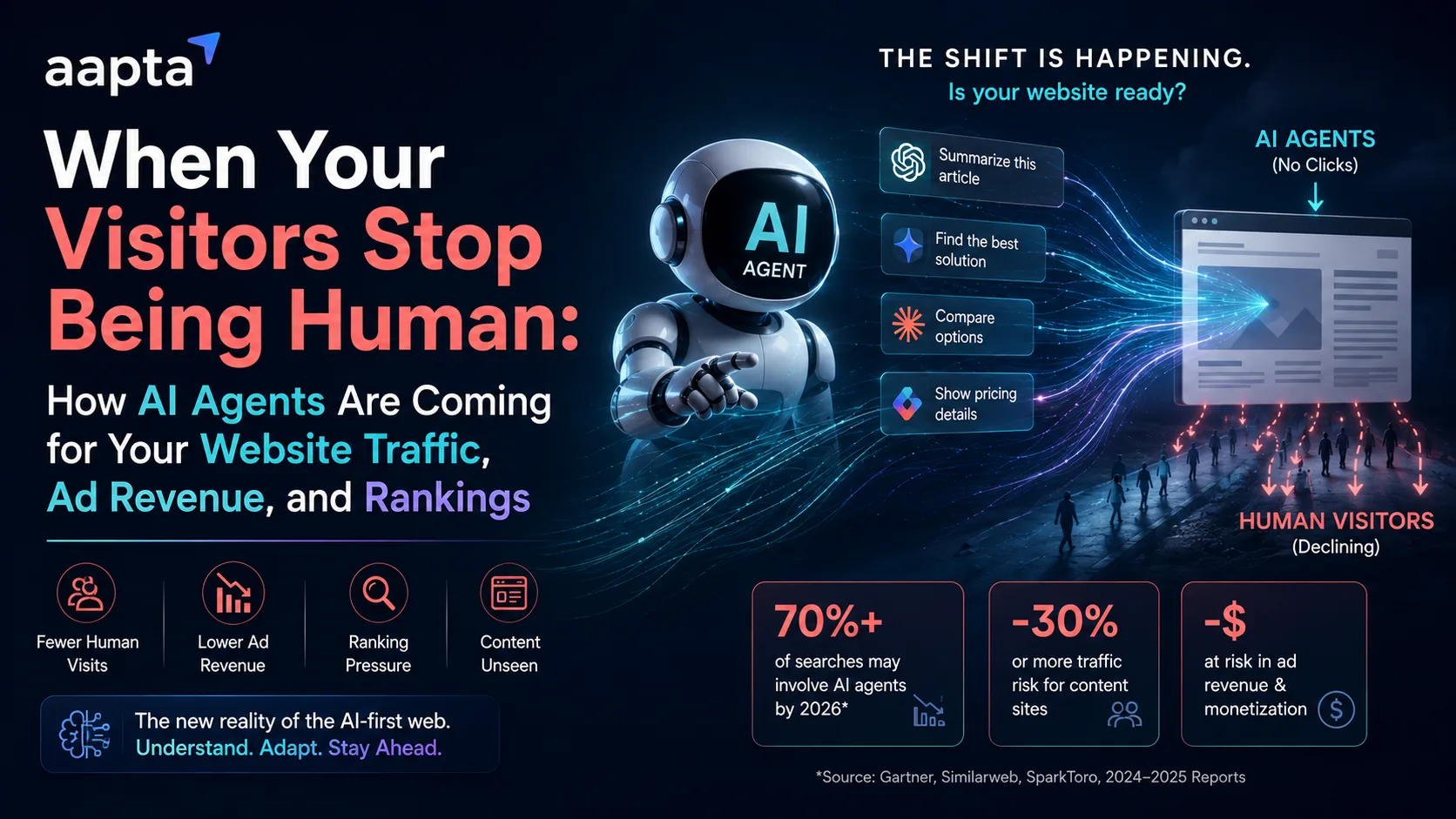
For the first time, most of the web's traffic is not human. In 2026 bots passed people online, and the fastest-growing kind is AI agents that browse, compare, and act on a person's behalf. This breaks the deal every website has quietly relied on for thirty years: that a visitor is a human who sees your pages, your ads, your brand, and your calls to action. AI agents do none of that. They extract the price, the spec, the answer, and leave, without viewing an ad, entering your funnel, or ever becoming a number you can monetise. The result, already visible, is falling human traffic, shrinking ad impressions, and a widening gap between how much your content is used and how little you are paid for it. This article is about that problem, not the fix. If you run a website, here is what is coming for your traffic, your ad revenue, your rankings, and your analytics, so you can start planning for it.
The milestone almost nobody noticed: bots passed humans
In June 2026, Cloudflare's data showed automated traffic overtaking human traffic on the web for the first time. Depending on who is counting, bots now make up roughly 53 to 57% of all web requests, with humans down to the low forties (Imperva Bad Bot Report 2026). Cloudflare Radar puts automated traffic near 57% of HTTP requests.
This is not the old story of spam bots and scrapers. The explosive growth is in agentic AI, the tools that do not just read a page but take action on it: click links, fill forms, compare options, and complete tasks for a human who never opens a browser. Traffic from these agents grew roughly 7,851% year over year, expanding about eight times faster than human activity (HUMAN Security, 2026). Commentators have started calling it the moment Dead Internet Theory stopped being a joke (Fortune, 2026).
A milestone in a benchmark report sounds abstract. It is not. It is the ground shifting under every business that depends on people visiting its website, and the shift attacks the money, the measurement, and the meaning of ranking all at once.
What AI agents actually do on your site (and what they don't)
To see the problem clearly, picture what an agent does versus what a human does.
A human lands on your page, sees your header and branding, reads at human speed, notices your ads, maybe clicks one, browses related products, gets nudged by your offers, and sometimes converts. Every step of that is monetisable, measurable, and brand-building.
An AI agent arrives to complete a task: "find the cheapest 2 BHK in Whitefield," "compare these three CRMs," "book the earliest slot." It reads your page in milliseconds, extracts exactly the data point it needs (the price, the spec, the availability), and moves on. It does not view your ads, because agents are built to extract information, not respond to display advertising. It does not see your carefully designed hero section. It does not get charmed by your brand. It does not enter your funnel. It can read hundreds of pages a second and generate none of the impressions, clicks, or attention your business runs on.
So your content is being consumed more than ever, and paid for less than ever. That gap is the whole problem, and it lands on your business in several specific ways.
A concrete example: one task, three businesses skipped
Picture a customer who tells their AI assistant, "book me a well-reviewed physiotherapist near Indiranagar for Saturday morning." A year ago that person runs a Google search, visits three clinic websites, reads reviews, sees each clinic's branding and offers, and calls one. Three businesses each got a shot at the traffic, the impression, and the relationship.
Now the agent does it. It reads the same three clinic pages in under a second, extracts ratings, availability, and price, picks one, and books, all without the human seeing a single clinic's website, ad, or brand. The two clinics that were not chosen got nothing: no visit, no impression, no chance to make their case. The one that was chosen got a booking but no brand impression, no upsell, and no relationship with a customer who does not even know its name. Multiply that across every category, every day, and you have the shape of the problem.
Problem 1: Human traffic to your website is going to fall
Start with the top of the funnel, because it is already shrinking.
When someone asks an AI assistant a question, the assistant increasingly answers directly, from content it read on sites like yours, without sending the person to any of those sites. Google's AI Overviews alone are reducing organic click-through by 18 to 47% depending on the query type. Now extend that from answering questions to completing tasks: an agent that books, buys, or compares on the user's behalf removes the visit entirely, not just for informational queries but for transactional ones too.
The uncomfortable truth is that a growing share of the value your website creates will be delivered to people who never arrive on it. Your words, prices, and data will show up inside an AI answer or an agent's decision, and the human on the other end will have no reason, and often no way, to click through. Fewer humans, more machines, is the new default, and I have written before about the early edge of this in why your website ranks on Google but is invisible in ChatGPT.
Problem 2: Ad monetisation breaks at the foundation
Now the money. The entire display-advertising model rests on one assumption: an impression is a human seeing an ad. Agents shatter that assumption.
Agents do not view ads, and the numbers already show it. Ad impressions have started declining, down around 11% year over year as automated traffic replaces human sessions (Search Engine Journal, 2026). For content businesses this is existential: publishers who once earned 90% or more of revenue from display ads are watching that fall to 40 to 60% of the mix, not because they chose to diversify but because the ad money is drying up underneath them.
Think about what this does to the bargain. You publish useful content. An AI reads it, uses it to answer a paying user or complete a paid task, and your reward is server load and a smaller ad cheque. The internet's business model, built on ad impressions, conversion funnels, and pageview analytics, assumed the visitor was a human being (Forbes, 2026). That assumption is now false for the majority of traffic, and every revenue model built on it inherits the crack.
Problem 3: Ranking #1 stops meaning what it used to mean
For twenty years the goal was simple: rank first, get the click, win the customer. Agents and AI answers are quietly severing the link between ranking and traffic.
You can rank number one and still get no visit, because the AI lifted your answer into its own response, or the agent read your page and acted without the human ever seeing a search result. Your position becomes an input to a machine's decision rather than a doorway a person walks through. The ranking still matters, in the sense that being the source the AI trusts is now valuable, but the thing it used to reliably deliver, a human on your page, is no longer guaranteed by it.
That is a hard shift for anyone who has invested years and budget in SEO measured by clicks and sessions. The metric that justified the spend, traffic from rankings, is being decoupled from the rankings themselves. I unpacked the wider version of this in the 2026 field guide to SEO, GEO, and AEO, and it is worth understanding how much the ground has moved.
Problem 4: Your analytics go blind, then misleading
Here is a problem that compounds all the others: you increasingly cannot tell who, or what, is visiting.
Agent traffic often arrives without clean identifiers, gets misclassified, or hides inside your "direct" and "referral" buckets. Your pageview counts inflate with machine visits while your human visits fall, so the top-line number can look stable even as the audience that actually buys shrinks. Conversion rates get noisy because the denominator is now part software. Bounce, time-on-page, and funnel metrics all assumed a human on the other end, and that assumption is quietly breaking your dashboards.
The danger is not just missing data, it is confident but wrong data. A business that keeps optimising for a traffic number it no longer understands can pour budget into growth that is really just more machines reading pages for free. Knowing whether AI is even engaging with your business at all is becoming its own discipline, which is why checking how AI engines see and use your content is turning into a basic health check rather than a nice-to-have.
Problem 5: Commerce and affiliate models get disintermediated
If you sell or earn commissions, the agent sits between you and your customer, and that position is powerful.
An agent doing the shopping compares options, reads reviews, checks prices, and increasingly completes the purchase, often through whatever rail is most machine-friendly, not through your carefully optimised product page and checkout. The parts of your site that do the selling, the persuasive copy, the bundle, the urgency, the upsell at checkout, are simply skipped. For affiliate and referral businesses it is worse: if the agent extracts the recommendation and transacts directly, the referral that paid you never fires. Agentic commerce is already reshaping how ads and buying work, and it does not have to route value through your interface to get the job done.
The strategic risk is disintermediation: the agent becomes the customer's interface, and your business becomes an interchangeable back-end data source it queries, with your margins, your brand, and your relationship with the buyer all thinning in the process.
Problem 6: Brand and discovery quietly erode
The last problem is the slowest and maybe the most dangerous, because you will not see it in a dashboard.
When an agent is the interface, the human never experiences your brand. They do not see your name, your design, your tone, your reviews, your story. They get an answer or an outcome, mediated by an AI that may not even mention you. Over time, the relationship that took you years to build, a customer who knows and trusts your brand, is replaced by a machine that treats you as one anonymous source among many. Discovery stops being something you win with a memorable site and becomes something an AI decides on the user's behalf, often without the user ever learning who you are.
That is how a business can stay "visible" to machines while becoming invisible to people, and it is very hard to notice until the pipeline of humans who actually remember you has already thinned.
Why this is different from every shift before it
Websites have survived disruptions before: mobile, social, the rise of Google, ad-blockers. Each changed how people arrived, but a person still arrived. What is different now is that the visitor itself is changing from a human into software, and the web was never built for that (Forbes, 2026).
Every layer of the stack, advertising, analytics, SEO, e-commerce, brand, was engineered around the assumption of a human on the other end. When most of your traffic stops being human, you are not facing a new channel to optimise for. You are facing the erosion of the assumption the whole thing was built on. That is why this deserves a place on the risk register of any business that depends on its website, right next to cash flow and key-person risk.
What every company should be worrying about now
This article is deliberately about the problem, not the answer. But naming what is at risk is the first step to planning for it. If your business touches the web, these are the questions to sit with:
- Traffic: if a growing share of humans get their answer from an AI and never visit, what happens to the top of your funnel over the next 18 to 24 months?
- Ad and content revenue: if impressions keep falling as agents replace human sessions, how exposed is your revenue to display advertising specifically?
- Ranking value: if ranking no longer reliably delivers a human click, what is your SEO investment actually buying you now?
- Analytics: can you even tell how much of your traffic and your "conversions" are human today, and is your reporting quietly misleading you?
- Commerce: if an agent does the comparing and buying, which parts of your selling process get skipped, and what does that do to margin and repeat business?
- Brand: if customers meet you through a machine that may not name you, how do you stay a brand people know rather than an anonymous data source?
None of these has a comfortable answer yet, and anyone claiming a tidy fix is selling something. The businesses that navigate this will be the ones that saw it early, understood it honestly, and started planning while they still had traffic and revenue to plan with. For context on how deep the change to search already runs, our pieces on whether you still need a website in 2026 and the broader shift to AI agents are worth reading alongside this one. This is the problem. What to do about it is a conversation worth having deliberately, and soon.
Frequently asked questions
Is it true that bots now make up most web traffic?
Yes. In 2026, automated traffic overtook human traffic on the web for the first time, with estimates putting bots at roughly 53 to 57% of all requests and humans in the low forties. The fastest-growing category is agentic AI, tools that take action on the web for a person, whose traffic grew nearly 8,000% year over year. This is a measured shift reported by multiple security and infrastructure firms, not a prediction.
Will AI agents actually reduce traffic to my website?
For human traffic, yes, and it is already happening. AI answers and agents increasingly deliver the value of your content, the price, the fact, the comparison, without sending the person to your site. Google's AI Overviews alone cut organic click-through by 18 to 47% depending on the query, and agents that complete tasks remove the visit entirely. Your content gets used more while human visits fall.
Do AI agents click on ads?
Generally no. AI agents are designed to extract information such as prices, specifications, and availability to complete a task, not to respond to display advertising. As automated traffic replaces human sessions, ad impressions have started falling (around 11% year over year), which is why businesses that depend heavily on display-ad revenue are the most exposed to this shift.
If I still rank #1 on Google, am I safe?
Less than you used to be. Ranking is being decoupled from traffic: you can rank first and still get no visit if the AI lifted your answer into its own response or an agent acted on your page without the human seeing a search result. Being the trusted source still has value, but the human click that ranking used to guarantee is no longer guaranteed.
How does this affect my analytics?
It makes them noisier and potentially misleading. Agent traffic is often misclassified or hidden in your direct and referral buckets, so pageviews can inflate with machine visits while human visits fall. Conversion rates get distorted because part of your traffic is now software. The risk is confidently optimising for a traffic number that no longer reflects the humans who actually buy.
Which businesses are most at risk?
Any business whose model assumes a human visitor. Content and media sites dependent on display ads are the most immediately exposed, followed by affiliate and referral businesses (agents can transact without firing the referral), and e-commerce where an agent skips your selling process. Service and local businesses feel it through lost discovery and eroded brand exposure as AI mediates the customer relationship.
Is there anything I can do about it?
There are responses, but this article is deliberately about understanding the problem first, because most businesses have not yet grasped the scale of it. The worst move is to keep operating as if the visitor is still reliably human. Start by honestly assessing your exposure across traffic, ad revenue, ranking value, analytics, commerce, and brand. What to actually do about each is a separate, deliberate conversation, and one worth having before the trend deepens.
About the author
Dharmendra Asimi is the founder of Aapta Solutions, established in 2007 and now serving SMBs and growing brands across India, the United States, and the United Kingdom. Over the past twenty years he has shipped WordPress builds, e-commerce stores, managed cloud hosting, and SEO programmes for hundreds of businesses (from single-product Shopify stores to multi-region WordPress estates handling Black Friday peaks).
He is the creator of Aapta GEO (a free 30-second AI-readiness scan) and Aapta SEO AI (a monthly tracker for how ChatGPT, Claude, Perplexity, and Gemini cite your content). His writing on web engineering and AI-search visibility is read by founders, marketing teams, and SEO managers across three time zones.
Areas of expertise: WordPress development at scale · managed cloud hosting (AWS, GCP, Azure, Cloudflare) · technical SEO · Generative Engine Optimization (GEO) · AI-search citation tracking · ecommerce architecture across WooCommerce, SureCart, Shopify, and Magento · Site Reliability Engineering for content platforms · brand strategy and visual identity.
Connect: LinkedIn · X · Instagram · personal site · About page · Contact Aapta
This article is maintained as part of Aapta's content quality programme. If any data point looks stale or incorrect next time you read this, tell us and we will verify and update within 48 hours.
Need help with this?
Our team has 19+ years of experience and can help you implement everything discussed in this article.
Book a Discovery Call