
The short answer
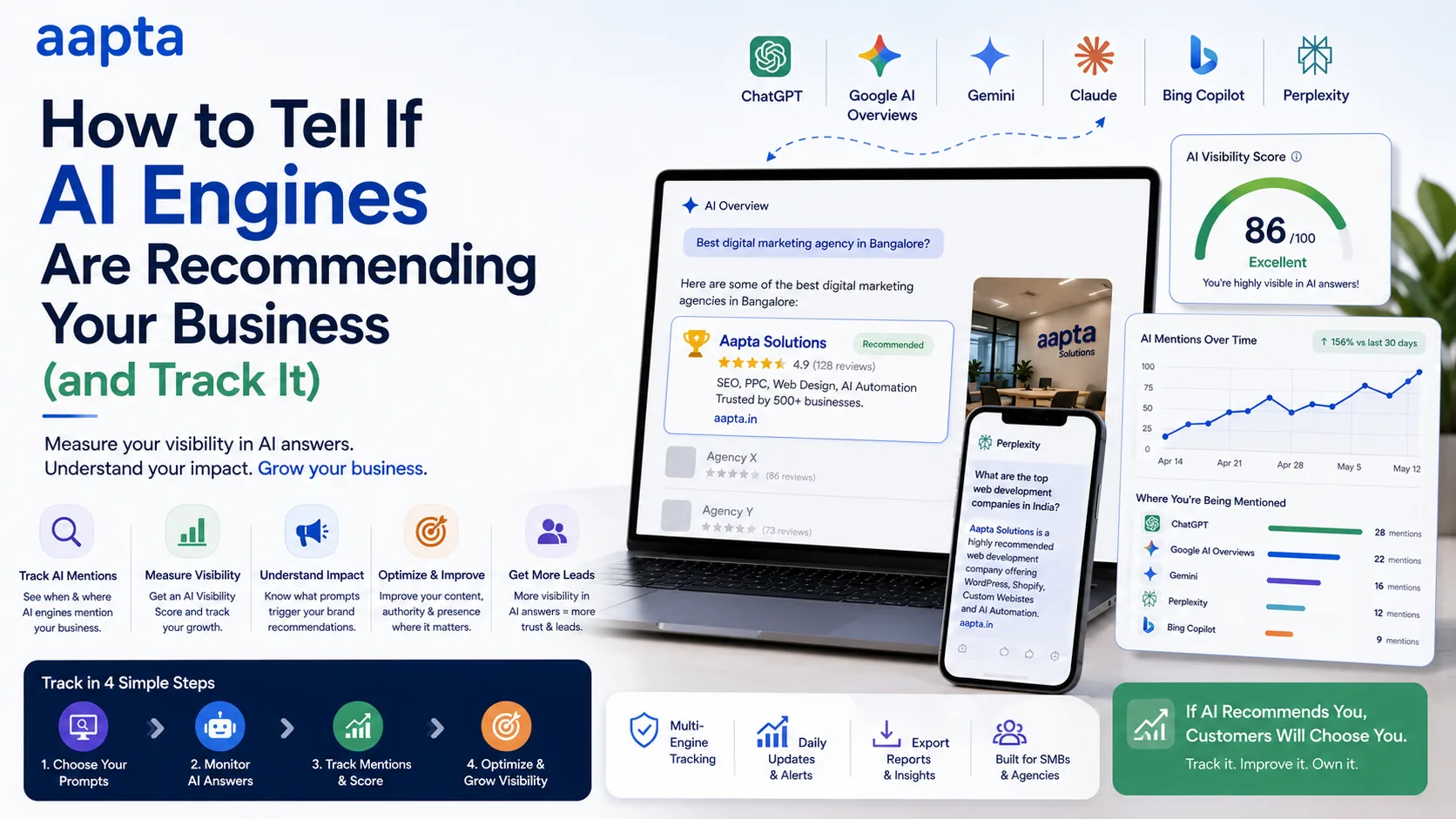
You cannot assume AI engines recommend your business. You have to check, and then track it, because what ChatGPT, Gemini, Perplexity, Copilot, and Google's AI answers say about you changes constantly and differs on every platform. The fastest way to start is manual: ask each engine the questions your customers ask ("best [your service] in [your city]", "[competitor] alternatives"), and record whether you appear, in what position, with what sentiment, and which sources it cites. But manual checking does not scale, because AI answers are probabilistic (the same prompt gives different results by timing, phrasing, and location) and the engines barely agree with each other (ChatGPT and Perplexity overlap on only about 11% of cited sources). There is also a measurement blind spot: around 70% of AI referral traffic arrives with no referrer, so Google Analytics misfiles it as "direct" and you never see it. To track AI recommendations properly you need a repeatable prompt set checked on a schedule across every engine, GA4 configured to catch AI referrals, and ideally a dedicated AI-visibility tool that reports your mention rate, share of voice, sentiment, and citations over time. This guide shows you exactly how, manually and with tools.
Why this matters: buyers act on what AI tells them
Before the "how", the "why", because this is not a vanity metric. Whether AI recommends you now moves revenue.
- 51% of B2B software buyers start their research with an AI chatbot more often than with Google, up from 29% a year earlier (G2, 2026).
- 69% chose a different vendor than they had planned based on AI guidance, and roughly one in three bought from a company they had never heard of before the AI named it (G2, 2026).
- AI-referred traffic converts far better than search. 2026 analyses put signup conversion around 15.9% for ChatGPT-referred visitors and 10.5% for Perplexity, against low single digits for organic search. The people AI sends you are further down the decision funnel.
So if ChatGPT is naming your competitor when a buyer asks for a recommendation, that is not a soft branding loss. It is a warm, high-converting buyer handed to someone else. The first step to fixing it is knowing it is happening.
How to check if AI recommends you right now (the manual method)
You can do a useful first audit in an afternoon, for free. Here is the process.
1. Build your prompt list. Write down the 10 to 20 questions a real buyer would ask, in their words, not yours. Mix the types:
- Category questions: "best [your service] in [your city]", "top [product type] for [use case]"
- Comparison questions: "[competitor] vs [competitor]", "alternatives to [competitor]"
- Problem questions: "how do I [the problem you solve]", "who can help me [job to be done]"
- Direct questions: "is [your business] any good", "what does [your business] do"
2. Ask each engine, one prompt at a time. Run every prompt through ChatGPT, Google's AI Mode and AI Overviews, Gemini, Perplexity, and Copilot. Use a logged-out or incognito session where you can, so your own history does not skew the answer.
3. Record five things for each answer. Do not just note "mentioned or not". Capture:
- Presence: did your business appear at all?
- Position: were you named first, in the middle, or last?
- Sentiment: was the mention positive, neutral, or negative?
- Accuracy: did it describe you correctly (services, pricing, location)?
- Sources: which websites did the answer cite? Are you one of them?
4. Note who it recommends instead. Every answer that names a competitor and not you is a specific, fixable gap.
Put it in a simple spreadsheet, one row per prompt, one set of columns per engine. Even this basic audit usually surprises people. The most common discoveries are that you are invisible for your core category terms, or that the AI describes you with a fact that is two years out of date.
Why manual checking is not enough
The afternoon audit is a snapshot. The problem is that AI recommendations are a moving target, and a single snapshot misleads you in four ways.
- Answers are probabilistic. The same prompt on the same engine can return different brands depending on timing, phrasing, location, and model version. One check is one roll of the dice, not the truth.
- The engines disagree with each other. They pull from different sources. ChatGPT leans on Wikipedia and LinkedIn, Perplexity leans heavily on Reddit, and separate research found only about 11% source overlap between ChatGPT and Perplexity. Winning on one tells you nothing about the others.
- It changes constantly. Models update, your content changes, competitors publish. A result from last month may not hold this month.
- It does not scale. Checking your brand manually across six to eight engines, for 20 prompts, several times a week, is simply not feasible for any team to sustain. You will do it once, learn something, and never do it again.
Manual checking is the right way to start and the wrong way to continue. To actually manage AI visibility, you need to measure the right things on a repeatable schedule.
The metrics that actually matter
When you move from a one-off audit to ongoing tracking, these are the numbers to watch. This is your AI-visibility scorecard.
| Metric | What it tells you | Why it matters |
|---|---|---|
| Presence / mention rate | % of relevant prompts where you appear at all | Your baseline visibility. You cannot be chosen if you are not mentioned |
| Position / rank | Where you appear in the answer (first, middle, last) | First-named brands get disproportionate attention and clicks |
| Share of voice | Your mentions vs competitors across a category | The single best measure of who is winning AI recommendations |
| Sentiment | Positive, neutral, or negative framing | The AI can mention you and still steer buyers away |
| Accuracy | Whether facts about you are correct | Hallucinated pricing or stale details actively cost you deals |
| Citations / sources | Which pages the answer pulls from | Tells you what content to strengthen to influence the answer |
Note the two metrics people forget: sentiment and accuracy. An engine can name you but describe you as "budget" when you have spent years positioning as premium, or recommend a competitor first in the same breath. And it can simply get facts wrong. These are invisible if you only track "mentioned yes or no", and they are exactly the failures that lose deals.
The hidden problem: AI traffic is nearly invisible in Google Analytics
Here is the measurement trap that catches almost everyone. Even when AI does recommend you and sends a visitor, you probably cannot see it in your analytics.
Across one dataset of 446,405 visits, 70.6% of AI referral traffic arrived with no referrer header, which means Google Analytics could not tell where it came from and filed it as "direct". Your GA4 "direct traffic" bucket is quietly hiding a growing stream of AI-referred visitors.
And that stream is growing fast. AI referrals are around 1% of all web traffic today but projected to reach a fifth or more of referral traffic by the end of 2026 (Digital Bloom, 2026). Among the AI traffic that is measurable, the split keeps shifting: ChatGPT still leads at roughly 63% of B2B AI referrals, but Claude has jumped to 18.5% and Gemini to about 10.6% as of early 2026, up from a near-total ChatGPT monopoly a year earlier.
To stop AI traffic hiding in "direct", set up GA4 to catch it:
- Create a custom channel group or segment that flags sessions with source containing
chatgpt,openai,perplexity,gemini,copilot,claude, or theutm_sourcevalues these tools sometimes pass. - Filter your "direct" traffic for landing pages that direct visitors rarely hit (deep blog posts, comparison pages). A spike of "direct" visits to an obscure page is often uncredited AI traffic.
- Watch referral traffic from
chatgpt.com,perplexity.ai, andgemini.google.com, which do sometimes pass a referrer.
This will not catch everything (the no-referrer problem is structural), but it turns an invisible channel into a partly visible one, and it is free.
How to track AI recommendations properly
Putting it together, here is the tracking system I recommend, from lightest to most complete.
- A scheduled manual audit. Keep your prompt spreadsheet and re-run it monthly. Tedious, but free, and better than nothing for a very small business.
- GA4 configured for AI referrals. Set up the channel grouping above so you can watch AI traffic volume and, crucially, its conversion rate. Given how well AI traffic converts, this is worth doing even for a small site.
- A dedicated AI-visibility tool. For anything beyond a handful of prompts, a purpose-built tracker checks your prompt set across every engine automatically, on a schedule, and reports mention rate, position, share of voice, sentiment, and citations over time. Options in the market include Otterly.ai, SE Ranking's ChatGPT visibility tracker, Profound, and Evertune, the latter two known for large-scale prompt testing that produces a statistically meaningful "share of AI voice" for a whole category. For a broader comparison of the category, independent roundups like Frase's AI-visibility tools list are a reasonable place to start.
- A tracker built for exactly this, at SMB pricing. This is precisely why we built Aapta SEO AI: it monitors how ChatGPT, Claude, Perplexity, and Gemini each cite and recommend your business, month over month, across your keywords and competitors, so you see all four engines in one place without the enterprise price tag. Start with a free Aapta GEO scan for a 30-second readiness snapshot, then track it properly from there.
The right level depends on your size. A local business with five core queries can live on a monthly manual audit plus GA4. A company whose buyers genuinely research on AI before purchasing should be tracking share of voice with a real tool, because at that point AI recommendations are a competitive battleground, not a curiosity.
What to do when AI gets you wrong (or ignores you)
Tracking only earns its keep if you act on it. The three common findings and their fixes:
- You are invisible for your category terms. This is a content and citation problem. AI engines recommend businesses they can read about in structured, credible, third-party content. The fix is Generative Engine Optimization: publishing clear, specific, well-structured content and earning mentions on the sources these engines trust. I covered the full playbook in why AI cites LinkedIn more than your website and the GEO readiness guide.
- The AI describes you wrong. Stale or incorrect facts usually trace back to outdated content about you on the web, or a thin entity record. Fix your own site's facts (a clear, current about page, structured data, consistent name-address-phone details), because that is what the engines increasingly cross-check. Our guide on why your website ranks on Google but is invisible in ChatGPT covers the entity-record side.
- A competitor is recommended first. Look at what the AI cites in those answers, then work to be present in and around those same sources. Share of voice is won source by source.
If you serve local customers, the same logic applies to "near me" style questions, which I break down in GEO for local businesses.
The India angle
For Indian businesses this is a rare early-mover window. AI adoption among buyers is climbing fast, but very few Indian companies are tracking their AI visibility yet, and even fewer are optimising for it. That means the category terms in most Indian niches are still up for grabs in ChatGPT and Gemini answers. A business that starts checking and improving its AI recommendations now, while competitors still assume "we rank on Google, so we are fine", can become the default AI recommendation in its space before the field wakes up. The measurement costs almost nothing to start. The cost of ignoring it is being the business AI never mentions while your competitor becomes the answer.
If you want this set up and tracked without doing it by hand, that is work we do. Start with our services, run a free scan on Aapta GEO, or just tell us your category and we will show you where you stand across the major AI engines today.
A worked example: what an AI-visibility check reveals
Say you run an interior design studio in Bengaluru. You build a prompt list and start checking, and the pattern that shows up is rarely what owners expect.
On ChatGPT, "best interior designers in Bengaluru" names three large firms and a directory listicle, but not you, even though you rank on page one of Google. On Gemini you appear third, described accurately. On Perplexity the answer is built almost entirely from a Reddit thread and a Quora post, and you are nowhere, because you have no presence on either. Copilot mirrors ChatGPT. Same business, same city, four different verdicts.
Two lessons fall out of this at once. First, your Google ranking did not carry over. Being on page one bought you nothing in three of the four engines, which is the whole reason "we rank on Google, so we are fine" is a trap. Second, the gap is specific and fixable. You are losing Perplexity because you are absent from the community sources it trusts, and losing ChatGPT because the listicles it cites do not include you. Those are two concrete pieces of work, not a vague "do more marketing".
This is why the audit comes before the optimisation. You cannot fix a visibility gap you have not located, and the gap is almost never uniform across engines. Track first, so the work you do afterwards targets the exact engine and source that is costing you the recommendation.
Frequently asked questions
How do I check if ChatGPT recommends my business?
Ask ChatGPT the questions your customers would ask, such as "best [your service] in [your city]" or "alternatives to [competitor]", ideally in a logged-out or incognito session so your history does not skew the result. Record whether your business appears, in what position, with what sentiment, whether the facts are correct, and which sources it cites. Repeat across Gemini, Perplexity, Copilot, and Google's AI Mode, because each engine answers differently. For ongoing tracking, use a dedicated AI-visibility tool rather than checking by hand.
Why does AI give a different answer every time I ask the same question?
Because AI answers are probabilistic, not fixed. The same prompt can return different brands depending on timing, phrasing, your location, and the model version in use. This is why a single manual check is unreliable and why proper tracking runs the same prompt set repeatedly on a schedule to see the true pattern rather than one random result.
Can I see AI traffic in Google Analytics?
Only partly, by default. In one large dataset, 70.6% of AI referral traffic arrived with no referrer header, so GA4 misclassified it as "direct". You can recover some visibility by building a custom channel group that flags sources like chatgpt, perplexity, and gemini, and by watching for unusual "direct" traffic to deep pages. But because the no-referrer problem is structural, GA4 alone will always undercount your AI traffic.
What metrics should I track for AI visibility?
Six: presence (mention rate), position (where you appear in the answer), share of voice (your mentions versus competitors), sentiment (positive, neutral, or negative framing), accuracy (whether the facts about you are correct), and citations (which sources the answer pulls from). Presence and share of voice tell you if you are winning; sentiment and accuracy catch the failures where you are mentioned but still lose the deal.
Do I need a paid tool, or can I track AI recommendations for free?
You can start for free with a monthly manual audit plus GA4 configured to flag AI referrals, which is enough for a very small business with a handful of core queries. Beyond that, manual checking does not scale across six to eight engines and dozens of prompts, so a dedicated tool becomes worth it. Aapta SEO AI is built for this at SMB pricing, tracking ChatGPT, Claude, Perplexity, and Gemini together.
Which AI engines should I track, not just ChatGPT?
At least ChatGPT, Google's AI Overviews and AI Mode, Gemini, Perplexity, and Copilot. ChatGPT still leads AI referrals at roughly 63% of the B2B share, but Claude has grown to around 18.5% and Gemini to 10.6% in early 2026, and the engines cite very different sources (ChatGPT and Perplexity overlap only about 11%). Tracking only ChatGPT leaves most of the picture invisible.
How often should I check my AI visibility?
For a manual audit, monthly is a sensible minimum, because answers shift as models and content change. With a dedicated tool that checks automatically, weekly or even daily tracking is normal, since it costs you no manual effort and lets you catch a sudden drop, a new competitor, or a hallucination quickly.
About the author
Dharmendra Asimi is the founder of Aapta Solutions, established in 2007 and now serving SMBs and growing brands across India, the United States, and the United Kingdom. Over the past twenty years he has shipped WordPress builds, e-commerce stores, managed cloud hosting, and SEO programmes for hundreds of businesses (from single-product Shopify stores to multi-region WordPress estates handling Black Friday peaks).
He is the creator of Aapta GEO (a free 30-second AI-readiness scan) and Aapta SEO AI (a monthly tracker for how ChatGPT, Claude, Perplexity, and Gemini cite your content). His writing on web engineering and AI-search visibility is read by founders, marketing teams, and SEO managers across three time zones.
Areas of expertise: WordPress development at scale · managed cloud hosting (AWS, GCP, Azure, Cloudflare) · technical SEO · Generative Engine Optimization (GEO) · AI-search citation tracking · ecommerce architecture across WooCommerce, SureCart, Shopify, and Magento · Site Reliability Engineering for content platforms · brand strategy and visual identity.
Connect: LinkedIn · X · Instagram · personal site · About page · Contact Aapta
This article is maintained as part of Aapta's content quality programme. If any data point looks stale or incorrect next time you read this, tell us and we will verify and update within 48 hours.
Need help with this?
Our team has 19+ years of experience and can help you implement everything discussed in this article.
Book a Discovery Call