
The short answer
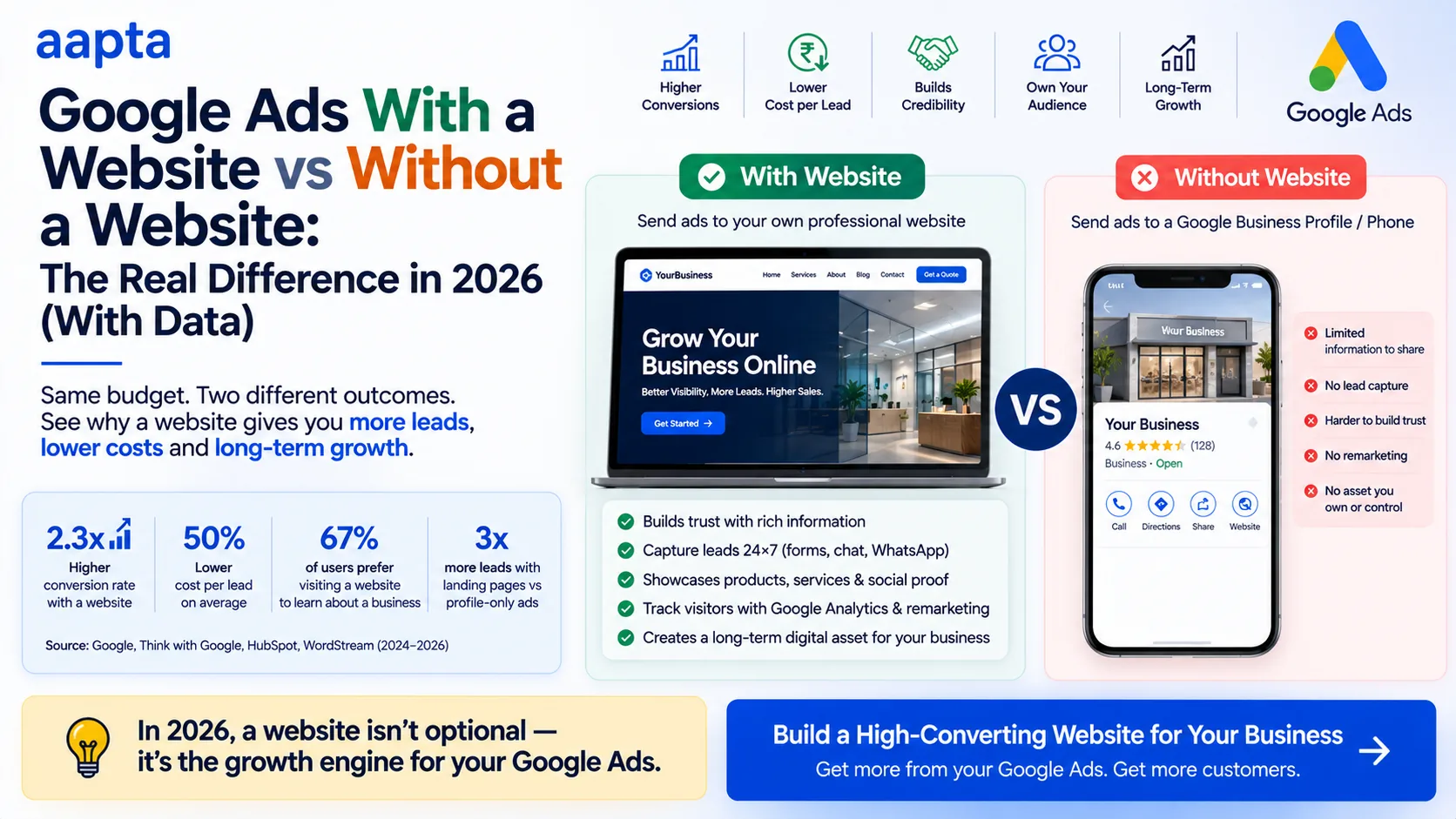
You can run Google Ads without a website, but only through a few formats: call-only ads, lead-form extensions, and, in the countries where Google offers them, Local Services Ads. For every other campaign type, Google requires a landing destination and quietly charges you more when that destination is weak. A website changes three things that decide whether paid search makes or loses money. First, a higher Quality Score, which lowers your cost per click. Second, conversion tracking, which is the only way Google's automated bidding can actually optimise toward sales instead of clicks. Third, remarketing, which lets you re-engage the 95%-plus of people who click your ad and leave without buying. Take the website away and you lose all three, plus Shopping ads entirely, plus the chance to build an asset that keeps working after you stop paying. Across industries the average Google Search conversion rate sits near 7% and the average click costs around $4 to $5 (LOCALiQ 2024 benchmarks). In India the clicks are far cheaper, but the same rules decide who wins. Here is every difference with the data, the honest exception where no-website ads still work, and a playbook for getting the most from every rupee.
Can you actually run Google Ads without a website?
Yes, but the list of formats that allow it is short, and it is shrinking.
- Call-only ads. The entire ad is a phone number. Someone taps it and their phone dials you. There is no landing page, so this format is genuinely website-free. It works only when a phone call is the conversion you want.
- Lead-form extensions (lead-form assets). A form opens inside Google's own interface when someone clicks. You collect the name, number, and email without sending anyone to a page you own. Google documents these lead forms as an asset you attach to search, video, and Performance Max campaigns.
- Local Services Ads (LSAs). The pay-per-lead ads with the green "Google Guaranteed" badge that sit above everything else. They pull from your Google Business Profile, not a website. Important caveat for readers in India: Local Services Ads have limited country and category availability, and they are not broadly available across India in 2026. For most Indian advertisers, the realistic no-website options are call-only ads and lead forms.
Everything else, meaning standard Search, Display, Performance Max, YouTube, and Shopping, needs a final URL. That URL does not strictly have to be your own domain. People do point ads at a Facebook page, a WhatsApp click-to-chat link, a Google Form, or a Linktree. But the moment your destination is a page you do not control and Google cannot properly read, you walk straight into the cost problem in the next section. And Shopping ads are impossible without a website, because they need a Merchant Center product feed pointing at real product pages.
So the honest framing is not "you cannot run ads without a website." It is "you can run a narrow slice of ad formats without a website, and you pay for the privilege in ways most owners never see on the invoice."
What actually changes when you add a website?
Five things change, and three of them are the difference between a campaign that scales and one that bleeds. Here is the summary before the detail.
| What changes | Without a website | With a website |
|---|---|---|
| Cost per click | Higher: Google cannot assess landing page experience, so Quality Score suffers | Lower: a fast, relevant page lifts Quality Score and cuts CPC |
| Conversion tracking | Call tracking or in-ad leads only. No keyword-to-sale visibility | Full tracking: keyword to form fill to sale, fed back to Smart Bidding |
| Remarketing | Not possible. No tag, no audience | Re-engage everyone who clicked and left |
| Ad formats available | Call-only, lead forms, LSAs (where offered) | Everything, including Shopping and Performance Max |
| What you own afterward | Nothing. Stop paying and it goes to zero | Traffic data, remarketing pool, SEO equity, first-party list |
Now the three that matter most.
How much does a website lower your cost per click?
This is the part almost nobody prices in. Google does not charge every advertiser the same for the same keyword. It runs an auction, and your position and price depend on your Ad Rank, which is built partly from your Quality Score.
Google's own documentation says Quality Score is estimated from three components:
- Expected click-through rate
- Ad relevance
- Landing page experience
Two of those three are directly about the page people land on. If you have no website, or you send traffic to a thin social page, Google either cannot measure landing page experience properly or measures it as poor. Your Quality Score drops. And Quality Score is not cosmetic. It sets what you pay.
WordStream's analysis of Google's Quality Score pricing, based on Google's published cost adjustments, found that a top Quality Score can cut your cost per click by up to 50%, while a low one can inflate it by up to 400%. Read that again. Two businesses can bid on the same keyword, and the one with the better landing page pays a fraction of what the other pays for the identical click. WordStream's breakdown of Quality Score and CPC lays out the exact discount and penalty curve.
For an Indian SMB spending ₹50,000 a month on Search, a Quality Score improvement from 4 to 8 can be the difference between 500 clicks and 900 clicks for the same budget. The website pays for a chunk of itself just by making every click cheaper. That is before it converts a single visitor.
Why is conversion tracking impossible to replace without a website?
Google's bidding is only as smart as the data you feed it. When you install the Google tag and conversion tracking on a website, every meaningful action becomes a signal: a form submitted, a call booked, a purchase completed, a quote requested. Google's Smart Bidding strategies (Maximise Conversions, Target CPA, Target ROAS) then learn which keywords, times, devices, and audiences actually produce sales, and shift your budget toward them automatically.
Without a website, that signal collapses to almost nothing. Call-only ads can track calls. Lead forms can track form fills. But you lose the connective tissue: which keyword drove which lead, which lead became revenue, which landing message converted and which one wasted spend. You are optimising on clicks and hoping. The algorithm that could be quietly compounding your results month after month has nothing to compound on.
This is the quiet killer. It does not show up as a line item. It shows up as a campaign that never gets more efficient, because the machine built to make it efficient was never given the data.
What is remarketing worth, and why does it need a website?
Here is a number that reframes the whole debate. Across industries, the average Google Search conversion rate is roughly 7% (LOCALiQ 2024). On many Display and top-of-funnel campaigns it is closer to 1%. That means the overwhelming majority of people who click your ad, often 90% to 99%, leave without converting on that first visit.
Remarketing is how you get them back. Google's remarketing tag drops a cookie or signal when someone visits your site, building an audience you can show ads to again later, usually at a much lower cost per conversion than cold traffic. It is frequently the single highest-return campaign in an account.
And it is flatly impossible without a website. No site, no tag. No tag, no audience. You get one shot at every expensive click, and when it misses, the money is gone. With a website, that same click also drops the visitor into a pool you can re-approach for weeks. One conversion surface becomes two.
The data on landing pages and ad performance
If the argument so far sounds like opinion, the benchmarks back it up.
- Dedicated landing pages beat homepages. HubSpot's research found that companies with 10 to 15 landing pages generate 55% more leads than those with fewer than 10. A homepage is built to serve everyone. A landing page is built to convert one specific ad's traffic.
- Speed decides conversions. Portent's 2022 study found a site that loads in 1 second has a conversion rate around 3x higher than one that loads in 5 seconds. Google's own data has long shown that 53% of mobile visits are abandoned if a page takes over 3 seconds to load. Every abandoned visit on an ad click is money you already paid for and lost.
- Search intent is where the buyers are. BrightEdge research attributes a large share of trackable website traffic to organic and paid search combined. People who search are people with intent. An ad captures that intent only if it has somewhere to send it.
- Paid search returns money when it is set up right. Google's own economic-impact modelling has long claimed businesses make roughly $2 in revenue for every $1 spent on Google Ads. That figure assumes a functioning conversion path, which for most campaign types means a website.
None of these numbers work in your favour without a page to land on.
Google Ads with vs without a website: the side-by-side
| Factor | Without a website | With a website |
|---|---|---|
| Setup speed | Fast: launch in a day | Slower: needs a page or site first |
| Upfront cost | Low: no build cost | ₹30,000 to ₹1,50,000 for a professional site in India (cost guide) |
| Cost per click | Higher (Quality Score capped) | Lower (better landing page experience) |
| Ad formats | Call-only, lead forms, LSAs | Search, Display, PMax, Shopping, YouTube, remarketing |
| Conversion tracking | Calls and in-ad leads only | Full funnel, keyword to revenue |
| Smart Bidding effectiveness | Weak: little data to learn from | Strong: compounds monthly |
| Remarketing | Impossible | Available and usually high-ROI |
| Message match | Generic destination | Ad-specific landing page |
| E-commerce (Shopping) | Not possible | Full catalogue selling |
| Trust and conversion rate | Lower: thin destination | Higher: reviews, detail, proof |
| What survives when ads stop | Nothing | Traffic data, SEO, list, remarketing pool |
| Best fit | Pure phone-lead local trades | Everyone else |
When does running ads without a website actually make sense?
I will not pretend the answer is never. There is a real, honest carve-out, and I have set up call-only campaigns for exactly these cases.
No-website Google Ads make sense when the conversion genuinely is a phone call and nothing else, and the buying decision is immediate. Think emergency and on-demand local trades:
- Plumbers, electricians, locksmiths
- AC and appliance repair
- Towing, roadside assistance, packers and movers
- Emergency medical or veterinary services
For these, someone searches "plumber near me open now," taps the call button, and books on the phone in ninety seconds. A website would add friction, not remove it. Call-only ads plus a well-optimised Google Business Profile can be genuinely profitable here, and I would not force a landing page into that flow just to make a point.
It can also make sense as a short demand test. Before you invest in a site, a two-week call-only or lead-form campaign tells you whether people are searching and whether they convert. If they do, you now have a data-backed reason to build. That is a smart, cheap experiment.
Outside those two situations, running ads without a website is usually a decision to pay more per click, learn less, remarket to nobody, and build nothing you keep. For a considered purchase, a B2B service, an online store, or anything where people research before they buy, the carve-out does not apply.
How do you get the most out of Google Ads?
Whether you already have a website or you are about to build one, this is the playbook I run for Indian SMBs. The website unlocks most of it.
- Send every ad to a dedicated landing page, not your homepage. If the ad says "GST-ready accounting software for retailers," the page should open with exactly that, and a single clear action. Message match is one of the biggest conversion levers there is.
- Get that page under 2.5 seconds LCP on mobile. Speed is a Quality Score input and a conversion input at the same time. Our speed-optimisation service exists precisely because most SMB pages fail Core Web Vitals, and every failure raises your ad costs.
- Install conversion tracking and GA4 before you spend a single rupee. Running ads without tracking is paying for a scoreboard you cannot see. Set up the Google tag, define conversions (form, call, purchase, quote), and confirm they fire.
- Turn on remarketing from day one. Tag every visitor so your first month of ad spend also builds an audience you can re-approach cheaply. Do not wait until "later." The pool starts filling the moment the tag is live.
- Feed offline conversions back to Google. For lead-gen, import which leads actually closed into revenue using offline conversion tracking. Now Smart Bidding optimises toward paying customers, not just form fills. This alone separates amateur accounts from serious ones.
- Build negative keyword lists aggressively. Every rupee spent on "free," "jobs," "salary," or an irrelevant match is a rupee stolen from a real buyer. Review search terms weekly for the first two months.
- Put WhatsApp click-to-chat and a call button on the landing page. In India, many buyers want to message before they commit. A page that offers WhatsApp chat alongside the form converts a slice of traffic that a form alone would lose.
- Match the offer to the keyword's intent. "Best CRM for clinics" is research intent; give it a comparison and a soft CTA. "CRM for clinics pricing" is buying intent; give it a price and a demo button. Same product, different pages.
- Let Smart Bidding run once you have real conversion volume. Aim for 15 to 30 conversions a month before handing bidding to Target CPA or Maximise Conversions. Below that, the algorithm is guessing; above it, it compounds.
- Measure everything to revenue, not clicks. Clicks and impressions are vanity. Cost per acquisition and return on ad spend are the truth. A campaign with fewer clicks and more sales wins every time.
Nine of those ten steps need a website. That is not a coincidence. The website is the surface the entire optimisation loop runs on.
What does this look like in India specifically?
The principles are global, but three things are worth calling out for Indian advertisers.
Clicks are cheap, so waste is cheap to accumulate. India has over 900 million internet users (IAMAI), and Google Search CPCs are a fraction of US levels. A click that costs $4.50 in the US might cost ₹15 to ₹150 here depending on the vertical. That low price tempts owners to run sloppy campaigns because each mistake feels small. It is not small at volume. Cheap clicks with no tracking and no landing page still add up to a wasted budget, just more slowly.
Payments and messaging shape the landing page. UPI now handles the large majority of India's retail digital payment volume (NPCI), so an e-commerce landing page that does not offer UPI is leaking sales. And WhatsApp is often the preferred contact channel, so a click-to-chat button frequently outperforms a plain form. A website lets you offer both. A call-only ad cannot.
Local Services Ads are not your no-website shortcut here. Because LSAs have limited availability in India, the "just use LSAs and skip the website" advice that works in the US does not transfer. For Indian SMBs, the practical choice is a proper website with tracked Search campaigns, or call-only ads for genuine phone-first trades. There is not much middle ground.
If you are still weighing whether a website is worth it at all, the paid-ads argument sits on top of a bigger one I made in do you still need a website in 2026, and the same logic drives local maps ranking with and without a website.
A simple decision framework
- Your conversion is a phone call, budget is tight, decision is immediate? Call-only ads, no website needed yet. Optimise your Google Business Profile instead.
- You want to test demand for two weeks before committing? Lead-form or call-only campaign. Build once the data says yes.
- You sell anything considered, online, or B2B? Website first, then ads. Running paid traffic into no landing page here is lighting money on fire.
- You sell products? Website plus Merchant Center, non-negotiable. Shopping ads do not exist without it.
- You want ad costs to fall and results to compound over time? Website. Quality Score, tracking, and remarketing are the three levers, and all three need one.
Paid ads and a website are not an either-or. The ads buy attention; the website converts it, lowers its price, and keeps a copy of it. Spend on ads without a website and you rent leads at the highest possible price. Spend on ads with a website and the same budget buys leads, cheaper clicks, a remarketing pool, and an asset that outlives the campaign.
If you want help setting up the landing pages, tracking, and remarketing properly, that is exactly the kind of work we do. Start at our services or just tell us what you are running and we will tell you honestly whether ads without a website make sense for your case.
Frequently asked questions
Can I run Google Ads without a website?
Yes, but only through call-only ads, lead-form extensions, and Local Services Ads where Google offers them. Standard Search, Display, Performance Max, and Shopping campaigns all require a landing destination, and Shopping specifically needs a website with a product feed. For most Indian advertisers without a site, call-only ads and lead forms are the only realistic options.
Is it cheaper to run Google Ads without a website?
It is cheaper upfront because you skip the build cost, but it is usually more expensive per result. Without a website Google cannot assess landing page experience, so your Quality Score is capped and your cost per click rises. WordStream's analysis of Google's pricing shows a poor Quality Score can inflate CPC by up to 400%. You save on the site and pay it back, often several times over, in higher click costs and lost conversions.
Do I need a website for Google Shopping ads?
Yes, absolutely. Shopping ads pull from a Google Merchant Center product feed, and that feed must point to real product pages with prices, descriptions, and checkout. There is no way to run Shopping campaigns without a website. If you sell products and want to advertise them on Google, a website is a hard requirement, not a nice-to-have.
What is a landing page and why does it matter for ads?
A landing page is a page built for one specific ad's traffic, with one message and one action, rather than a general homepage. It matters because message match drives conversions: HubSpot found businesses with 10 to 15 landing pages generate 55% more leads than those with fewer than 10. A dedicated page also loads faster and stays focused, both of which lift your Quality Score and lower your cost per click.
Can I use my Google Business Profile instead of a website for ads?
For Local Services Ads and some local Search formats, your Google Business Profile can serve as the destination, which is genuinely useful for phone-first local businesses. But a Business Profile cannot host conversion tracking, remarketing tags, dedicated landing pages, or a checkout. So it works for a narrow set of call-driven cases and falls short the moment you want to track, optimise, remarket, or sell online.
How much does a website cost if I only want it for Google Ads?
In India, a professional site suitable for paid campaigns typically runs ₹30,000 to ₹1,50,000 depending on scope, and a focused set of landing pages can cost less. Given that a better Quality Score can cut your cost per click substantially and remarketing often becomes your highest-return campaign, the site frequently pays for itself through cheaper, better-converting ad traffic. See our website cost breakdown for the full picture.
Will running Google Ads help my SEO?
Not directly. Google has stated repeatedly that paid ads do not improve your organic rankings; they are separate systems. But they compound indirectly. Ad traffic builds remarketing audiences, reveals which keywords and messages convert (intelligence you can apply to your SEO and content), and grows brand searches that do help over time. The website is what lets paid and organic feed each other instead of running in isolation.
What if I already run ads to a Facebook or Instagram page?
You can, and some businesses do, but you inherit the same limitations as running with no website: capped Quality Score, weak tracking, no remarketing pixel of your own, and a destination you do not fully control. You are also one policy change or outage away from losing the destination entirely. A website removes that platform dependency, which is a risk I break down in the website vs social platforms comparison.
About the author
Dharmendra Asimi is the founder of Aapta Solutions, established in 2007 and now serving SMBs and growing brands across India, the United States, and the United Kingdom. Over the past twenty years he has shipped WordPress builds, e-commerce stores, managed cloud hosting, and SEO programmes for hundreds of businesses (from single-product Shopify stores to multi-region WordPress estates handling Black Friday peaks).
He is the creator of Aapta GEO (a free 30-second AI-readiness scan) and Aapta SEO AI (a monthly tracker for how ChatGPT, Claude, Perplexity, and Gemini cite your content). His writing on web engineering and AI-search visibility is read by founders, marketing teams, and SEO managers across three time zones.
Areas of expertise: WordPress development at scale · managed cloud hosting (AWS, GCP, Azure, Cloudflare) · technical SEO · Generative Engine Optimization (GEO) · AI-search citation tracking · ecommerce architecture across WooCommerce, SureCart, Shopify, and Magento · Site Reliability Engineering for content platforms · brand strategy and visual identity.
Connect: LinkedIn · X · Instagram · personal site · About page · Contact Aapta
This article is maintained as part of Aapta's content quality programme. If any data point looks stale or incorrect next time you read this, tell us and we will verify and update within 48 hours.
Need help with this?
Our team has 19+ years of experience and can help you implement everything discussed in this article.
Book a Discovery Call