
The short answer
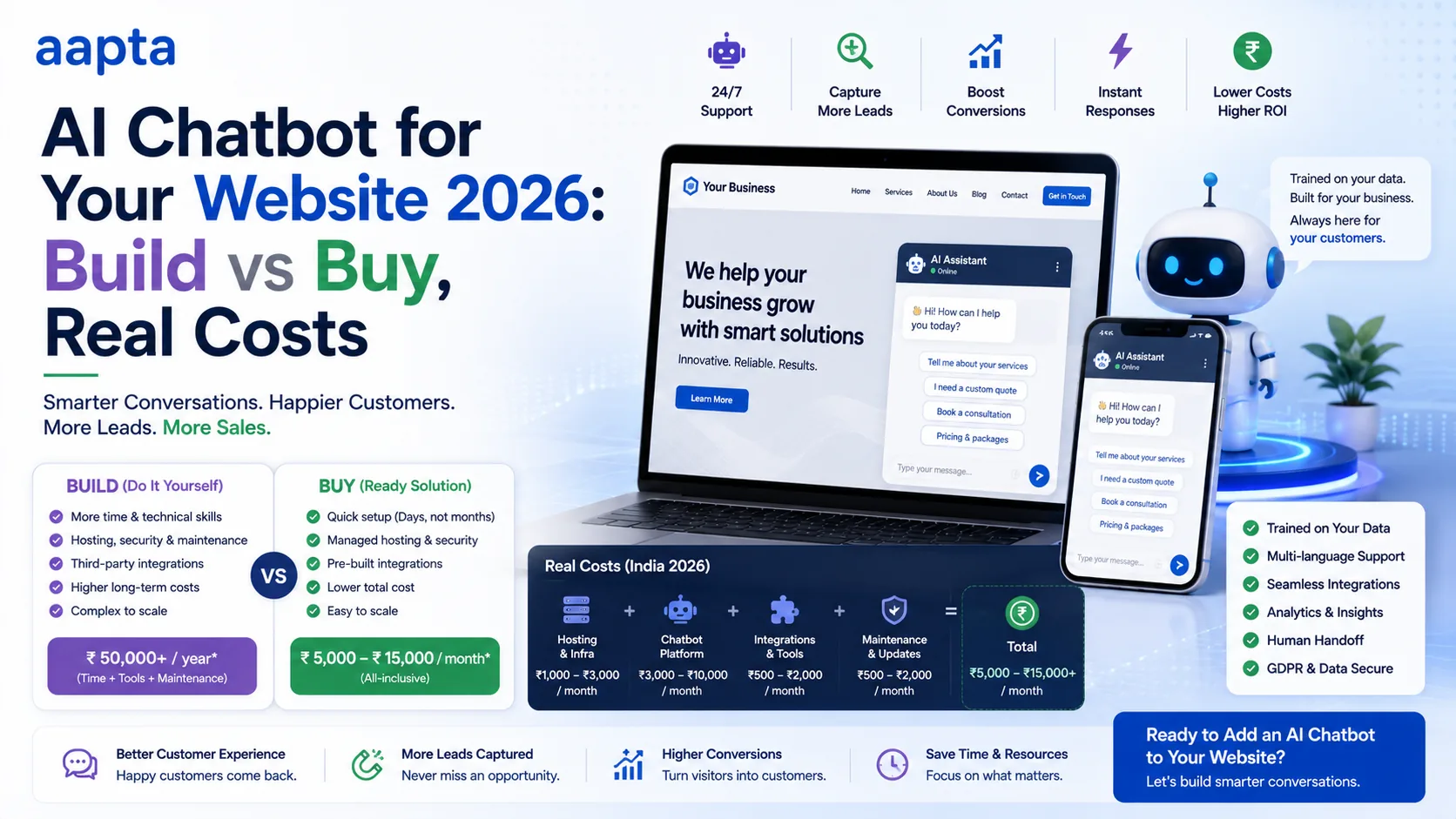
For most businesses in 2026 the right answer is buy first, build later, and expect less than the marketing promises. A bought SaaS chatbot (Intercom Fin, Tidio's Lyro, Chatbase) gets you live in days and handles tier-1 questions well, but its per-resolution pricing means the better it works, the more you pay: Intercom charges $0.99 per resolution and Zendesk $1.50, on top of seats, and costs scale straight up with volume. Building a custom chatbot on a RAG pipeline plus an LLM API costs roughly $15,000 to $50,000 for a solid production MVP and 8 to 14 weeks, but then runs on cheap per-token costs you control, often a few hundred dollars a month even at scale once prompt caching is on. The catch nobody advertises: genuine end-to-end resolution is 30 to 60% for most teams, and median measured deflection is around 14%, so scope it to deflect your repetitive questions and escalate the rest, not to replace your team. This guide breaks down both paths, the real one-year costs at three volumes, the India numbers, and a decision framework.
What an "AI chatbot" actually means in 2026
First, a definition, because the word covers two very different things and the confusion costs people money.
The old chatbot was a scripted flow: decision trees, buttons, "Press 1 for sales". Cheap, dumb, and hated by customers. That is not what this article is about.
The 2026 AI chatbot is a retrieval-augmented (RAG) assistant: it reads your website, help docs, and product data, then uses a large language model (OpenAI, Claude, Gemini) to answer questions in natural language, grounded in your actual content. When someone asks "do you support Razorpay subscriptions?", it does not match a keyword, it retrieves the relevant page and writes an answer. That capability is what makes the build-vs-buy question worth asking, because both a bought platform and a custom build now use the same underlying technique.
The key insight: the model is a commodity you can rent. The value is in the retrieval, the guardrails, the integrations, and the escalation. That is true whether you buy or build.
The honest truth about resolution rates
Before any cost math, reset your expectations, because this is where businesses overpay and then feel cheated.
Vendors advertise 80% or 90% "resolution". The measured reality is very different:
- Genuine end-to-end resolution (the AI actually solved the problem, no human needed) runs 30 to 60% for most teams, reaching 70 to 85% only where the AI is deeply integrated, allowed to take actions, and tightly guardrailed (Lorikeet, 2026).
- Median measured deflection across teams using an AI chatbot is about 14% (HubSpot), far below the marketing.
- Crucially, resolution is not deflection. Deflection counts conversations a human never touched. Resolution counts problems actually solved. A bot can "deflect" a frustrated customer who simply gives up, which is a loss dressed as a win.
Why does this matter for build vs buy? Because if you believe the 90% number, you will over-buy an expensive per-resolution plan expecting it to replace headcount, then pay premium rates for mediocre outcomes. If you scope realistically (deflect the repetitive 30 to 50%, escalate the rest cleanly), both buying and building become far cheaper and more successful. Set the target at "handle the FAQ-shaped questions well and hand off gracefully", not "fire the support team".
The good news that makes it worth doing anyway: an AI resolution averages $0.62 versus $7.40 for a human agent (McKinsey, 2026), and CSAT on AI-handled tickets is 4.10 out of 5 versus 4.30 for humans, a gap that nearly closes with a good escalation flow. Even a 40% deflection rate is real money and acceptable satisfaction.
Option 1: Buy a SaaS chatbot
The fast path. You sign up, point the platform at your website and docs, configure escalation, and go live in days.
How the pricing works. This is the part to understand, because SaaS chatbot pricing in 2026 is mostly usage-based, and that changes everything:
| Platform | Model | Indicative 2026 price |
|---|---|---|
| Intercom Fin | Per resolution + seats | $0.99 / resolution + seats ($29–$132/seat/mo), 50-resolution minimum |
| Zendesk AI | Per resolution | ~$1.50 / resolution |
| Tidio (Lyro AI) | Tiered conversations | Base $29/mo; Lyro $39/mo (50 convos) to $289/mo (500 convos) |
| Chatbase | Credit-based | From $19/mo; ~$40 per 1,000 extra credits |
Pricing per alhena.ai and Tidio, 2026.
The buy advantages:
- Live in days, not months. No development, no infrastructure.
- Maintained for you. Model upgrades, uptime, security are the vendor's problem.
- Good tier-1 quality out of the box. For FAQ-shaped questions, the leading platforms are genuinely competent.
- Low commitment. You can test the idea before investing in a build.
The buy disadvantages:
- The per-resolution trap (detailed below): the better it works, the more you pay.
- Costs scale with volume, forever. There is no point where the meter stops.
- Limited depth. Complex, multi-step, or deeply integrated workflows often hit the platform's ceiling.
- Your data and logic live on their infrastructure. Portability is limited.
Option 2: Build a custom chatbot
The controlled path. You build a RAG pipeline (ingest your content, embed it, retrieve relevant chunks) wired to an LLM API, with your own guardrails, integrations, and escalation.
What it costs to build, per 2026 development benchmarks:
- Pilot, one use case: $5,000 to $15,000
- Production MVP, 2 to 3 integrations: $15,000 to $50,000
- Full custom, multi-channel, multi-source RAG, agentic actions: $50,000 to $150,000, 8 to 14 weeks
What it costs to run. This is where building wins long-term. You pay per token to the LLM API, and modern pricing plus caching makes that cheap:
- Capable base models are priced per million tokens, and a typical chatbot workload runs in the low hundreds of dollars a month per LLM API pricing comparisons.
- Prompt caching changes the economics. Cached context runs 50 to 90% cheaper than fresh tokens. A chatbot with a large static system prompt and RAG context, at high volume, can save tens of thousands of dollars a month with caching versus paying full price every call.
The build advantages:
- Cheap to run at scale. Per-token costs do not punish success the way per-resolution pricing does.
- You own it. Your data, your logic, your infrastructure, fully portable.
- No ceiling. Any integration, any workflow, any channel you can code.
- Model-agnostic. Swap OpenAI for Claude for Gemini as prices and capabilities shift.
The build disadvantages:
- Upfront cost and time. Weeks and real money before it answers a single question.
- You own the maintenance too. Model updates, prompt tuning, retrieval quality, uptime.
- Needs the right team. A bad RAG build is worse than a good SaaS bot.
The real cost comparison over one year
Here is the math that actually decides it, at three monthly resolution volumes. Buy assumes Intercom Fin ($0.99/resolution) plus two Advanced seats; build assumes a $30,000 production MVP amortised over year one plus operating cost.
| Monthly resolutions | Buy (SaaS) year 1 | Build (custom) year 1 | Build year 2+ |
|---|---|---|---|
| 500 | ~$8,000 | ~$32,000 (build + ~$1,200 ops) | ~$1,500 |
| 2,000 | ~$26,000 | ~$33,000 (build + ~$3,000 ops) | ~$3,500 |
| 10,000 | ~$120,000 | ~$40,000 (build + ~$9,000 ops) | ~$10,000 |
The pattern is clear. At low volume, buy wins because there is no build cost to amortise. At high volume, build wins decisively because SaaS per-resolution pricing scales linearly to six figures while a build runs on cheap tokens. The crossover for most businesses sits somewhere between 1,500 and 3,000 resolutions a month. Below it, buy. Well above it, build. Around it, model both against your real volume.
Note what happens in year two: the build cost is already paid, so a custom bot handling 10,000 resolutions a month runs at roughly $10,000 for the year, while the SaaS equivalent bills $120,000 again. The gap compounds every year you keep it.
The per-resolution pricing trap
This deserves its own section because it catches people. Per-resolution SaaS pricing has a perverse incentive baked in: the better your chatbot performs, the more you pay. Improve your help docs so the bot resolves more questions, and your bill goes up, not down. Grow your traffic, and it goes up again. Your cost is coupled to your success and your scale, permanently.
Flat-rate and credit-based platforms (Tidio, Chatbase) avoid the linear scaling but cap capability or throttle you at volume. And a build decouples cost from resolution entirely: whether the bot resolves 500 or 5,000 questions, you pay for tokens, not outcomes.
This is not an argument against buying. For a business doing a few hundred resolutions a month, per-resolution pricing is cheap and the build cost would never pay back. It is an argument against buying without modelling your 18-month volume, because a plan that is cheap at 300 resolutions can be brutal at 5,000.
So which should you choose? A decision framework
- Just validating the idea, or under ~1,500 resolutions/month? Buy. Get live in days on Tidio, Chatbase, or Intercom Fin, scope it to your top FAQs, and measure real deflection before spending on a build.
- High volume (several thousand resolutions/month) and it is core to your operation? Build, or you will pay the per-resolution tax forever. The build pays back inside a year at that scale.
- Need deep, custom, multi-step workflows or tight integration with your CRM, orders, or internal systems? Build, because you will hit the SaaS ceiling.
- Most companies? Hybrid. Around 70% of serious 2026 deployments run hybrid: buy a SaaS bot for routine tier-1, build custom for the workflows that differentiate you. This is the same buy-for-commodity, build-for-differentiation logic I applied to automation tooling in self-hosted n8n vs Zapier.
The India angle
Two things shift the maths for Indian businesses.
Building is cheaper here. The $15,000 to $50,000 MVP band reflects global rates. In India, a competent production RAG chatbot MVP often lands well below that, which moves the build-vs-buy crossover down: building becomes worthwhile at lower volumes than the global numbers suggest, because your build cost to amortise is smaller. Meanwhile SaaS per-resolution pricing is charged in dollars regardless of where you are, so the buy side does not get the same local discount.
WhatsApp is the channel that matters. For most Indian businesses the highest-value chatbot is not on the website at all, it is on WhatsApp, where your customers already are. That changes the build-vs-buy decision, because website chat widgets and WhatsApp automation have different plumbing. I cover the WhatsApp side in adding WhatsApp chat and automation without a big BSP bill and the WhatsApp Business API costs and setup. Often the right 2026 stack is a website RAG bot plus a WhatsApp automation, sharing the same knowledge base.
If you want this scoped and costed against your actual volume, that is exactly the work we do at Aapta's AI and automation services, and it slots alongside the broader automation workflows for Indian SMBs that most businesses should run first.
How to get it right, whichever you pick
The build-vs-buy choice matters less than the execution. Whichever path you take:
- Scope to deflect, not to replace. Point it at your repetitive, FAQ-shaped questions first. That is where 30 to 50% deflection is realistic and valuable.
- Design the escalation before the answers. The single biggest driver of CSAT is a clean handoff to a human when the bot is unsure. Never trap the customer.
- Feed it good content. A RAG bot is only as good as your docs. Fixing your help content lifts resolution on both bought and built bots.
- Guardrail it. Constrain it to your domain, make it say "I do not know" rather than hallucinate, and log everything.
- Measure resolution, not deflection. Track whether problems were actually solved and whether customers came back. Deflection alone flatters a bad bot.
- Review the transcripts weekly for the first two months. The failure patterns you find become your next round of content and guardrails.
- Start with one channel, not all of them. A website widget, WhatsApp, and in-app chat each add their own integration work and cost. Nail deflection on your single highest-traffic channel first, prove the resolution rate on real conversations, then expand. Spreading a first deployment across three channels at once is the fastest way to end up with a mediocre bot everywhere and a genuinely good one nowhere.
Frequently asked questions
How much does an AI chatbot for a website cost in 2026?
If you buy SaaS, expect usage-based pricing: Intercom Fin at $0.99 per resolution plus seats, Zendesk at about $1.50 per resolution, or flat tiers like Tidio's Lyro ($39 to $289/month) and Chatbase (from $19/month). If you build, a solid production MVP runs $15,000 to $50,000 with 8 to 14 weeks of work, then a few hundred dollars a month to operate. At low volume buying is cheaper; at high volume building wins because SaaS per-resolution costs scale to six figures.
Should I build or buy an AI chatbot?
Buy if you are validating the idea or handling under roughly 1,500 resolutions a month, because there is no build cost to amortise. Build if you are at high volume, need deep custom workflows, or the chatbot is core to your operation, because the per-resolution SaaS bill overtakes a build within a year at scale. Most companies end up hybrid: buy for routine tier-1, build for the workflows that differentiate them.
What resolution rate can an AI chatbot actually achieve?
Far less than vendors claim. Genuine end-to-end resolution is 30 to 60% for most teams, reaching 70 to 85% only with deep integration and tight guardrails, and HubSpot's median measured deflection is about 14%. Scope your chatbot to handle repetitive FAQ-shaped questions and escalate the rest cleanly, rather than expecting it to replace your support team. Even 40% deflection is real savings, since an AI resolution costs about $0.62 versus $7.40 for a human agent.
What is the difference between an AI chatbot and an old scripted chatbot?
An old chatbot follows a fixed decision tree with buttons and keyword matching. A 2026 AI chatbot uses retrieval-augmented generation: it reads your website and docs, retrieves the relevant content, and uses a large language model to answer in natural language grounded in your actual information. The RAG approach is why modern bots can answer questions they were never explicitly scripted for, and why both bought and built chatbots now use the same underlying technique.
Why is per-resolution chatbot pricing a problem?
Because it couples your cost to your success. The better your chatbot resolves questions, and the more your traffic grows, the higher your bill, forever. Improving your help docs to lift resolution literally increases what you pay. It is fine at low volume, but at a few thousand resolutions a month it becomes expensive, which is why high-volume users often build a custom bot that runs on cheap per-token costs decoupled from outcomes.
Which LLM should a custom chatbot use, OpenAI, Claude, or Gemini?
For most website chatbots any of the capable base models work well, so choose on price, latency, and prompt caching for your workload rather than brand. Caching matters most: cached context runs 50 to 90% cheaper than fresh tokens, so a model with strong caching and a large static system prompt often wins on real cost. A well-built RAG pipeline lets you swap models as prices and capabilities shift, which is a core reason to build model-agnostic.
How long does it take to launch an AI chatbot?
Buying gets you live in days: sign up, point the platform at your content, configure escalation. Building takes 8 to 14 weeks for a production MVP with a couple of integrations, longer for multi-channel or agentic workflows. If speed to launch is the priority, buy first and validate, then build later if volume or complexity justifies it.
Is an AI chatbot worth it for a small business in India?
Often yes, especially because building is cheaper in India than the global cost bands suggest, which makes a custom bot worthwhile at lower volumes. For many Indian businesses the highest-value bot is on WhatsApp rather than the website, since that is where customers already are. Start by scoping it to deflect your most repetitive enquiries, measure the real resolution rate, and expand from there.
About the author
Dharmendra Asimi is the founder of Aapta Solutions, established in 2007 and now serving SMBs and growing brands across India, the United States, and the United Kingdom. Over the past twenty years he has shipped WordPress builds, e-commerce stores, managed cloud hosting, and SEO programmes for hundreds of businesses (from single-product Shopify stores to multi-region WordPress estates handling Black Friday peaks).
He is the creator of Aapta GEO (a free 30-second AI-readiness scan) and Aapta SEO AI (a monthly tracker for how ChatGPT, Claude, Perplexity, and Gemini cite your content). His writing on web engineering and AI-search visibility is read by founders, marketing teams, and SEO managers across three time zones.
Areas of expertise: WordPress development at scale · managed cloud hosting (AWS, GCP, Azure, Cloudflare) · technical SEO · Generative Engine Optimization (GEO) · AI-search citation tracking · ecommerce architecture across WooCommerce, SureCart, Shopify, and Magento · Site Reliability Engineering for content platforms · brand strategy and visual identity.
Connect: LinkedIn · X · Instagram · personal site · About page · Contact Aapta
This article is maintained as part of Aapta's content quality programme. If any data point looks stale or incorrect next time you read this, tell us and we will verify and update within 48 hours.
Need help with this?
Our team has 19+ years of experience and can help you implement everything discussed in this article.
Book a Discovery Call