
The short answer
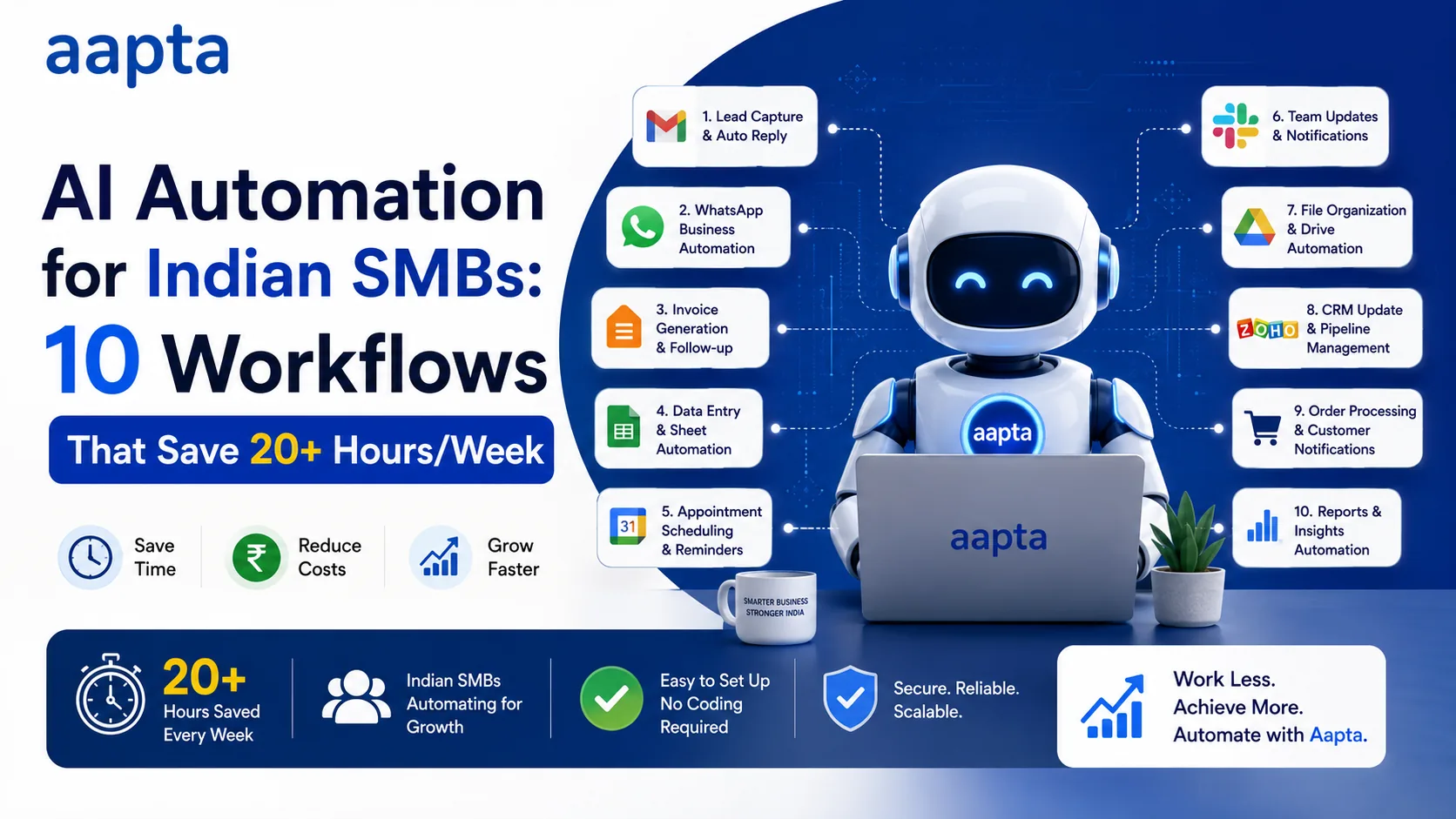
Most Indian small businesses do not need "AI" in the buzzword sense. They need to stop doing five boring, repetitive tasks by hand. Indian SMBs that automate just 3 to 5 core workflows save 20 to 30 hours a week and ₹15,000 to 25,000 a month in staff-cost, according to 2026 India SMB automation data, and most recover the setup cost within 2 to 4 months. The highest-value workflows are unglamorous: capturing every lead automatically, replying on WhatsApp instantly, chasing invoices, requesting reviews, sending appointment reminders, and drafting routine replies. You run them on an automation engine like n8n connected to WhatsApp, your CRM, and AI, and the smartest setup for an Indian business is to self-host that engine on your own server so your data stays in India and your cost stays flat regardless of volume. This guide gives you 10 concrete workflows, the tools that run them, the real setup cost, and where to start.
Stop chasing "AI". Start removing manual work.
Here is the mistake I watch Indian business owners make with AI. They read that AI is the future, they feel behind, and they go looking for "an AI" to buy, as if it were a single product. Then they either overspend on something generic they never use, or they freeze because it all feels too big.
The businesses actually getting value in 2026 do the opposite. They ignore the word "AI" entirely and ask one question: which repetitive task is eating my team's day? Then they automate that one thing. India is leading this shift, not lagging it. Per 2026 AI adoption data, 59% of Indian SMBs already use AI in their operations, generative AI usage among small firms jumped from about 40% in 2024 to over 58% in 2026, and roughly 63% report using it daily with real productivity gains. The gap now is not adoption. It is knowing which workflows to automate first.
Automation is not the same as AI, and you do not always need AI in the loop. Some of the highest-value workflows below are pure automation (move data from A to B, send a message on a trigger). Others use AI for the part that needs judgment (drafting a reply, reading a document, answering a question). The winning setup mixes both.
What it actually saves you
Before the workflows, the numbers, because "save time" is too vague to act on.
| Outcome | Figure | Source |
|---|---|---|
| Time saved with 3-5 core workflows | 20-30 hours/week | GrowAI, 2026 |
| Staff-cost saving (India) | ₹15,000-25,000/month | GrowAI, 2026 |
| Operational overhead reduction | 20-35% within 6 months | Creworklabs, 2026 |
| Time to recover setup cost | 2-4 months | GrowAI, 2026 |
| Indian SMBs already using AI | 59% | CXO Voice, 2026 |
Twenty to thirty hours a week is most of a full-time person. For a small team, that is the difference between the owner working in the business (answering the same WhatsApp question for the hundredth time) and working on the business. That is the real return, not a line on a spreadsheet.
The 10 workflows, ranked by how fast they pay back
Here are the ten I would set up for a typical Indian SMB, roughly in the order I would do them. Each lists what it does, the time it tends to save, the tools, and who it suits best. You do not need all ten. Pick the two or three that match your biggest daily pain.
| # | Workflow | Typical time saved | Best for |
|---|---|---|---|
| 1 | Lead capture to CRM + instant reply | 5-8 hrs/wk | Everyone |
| 2 | WhatsApp auto-response + lead qualification | 6-10 hrs/wk | Service, retail, clinics |
| 3 | Invoice creation + payment reminders | 3-5 hrs/wk | Everyone who bills |
| 4 | Review requests after purchase | 2-3 hrs/wk | Local businesses |
| 5 | Appointment + booking reminders | 4-6 hrs/wk | Clinics, salons, consultants |
| 6 | AI-drafted quote and email replies | 4-7 hrs/wk | Agencies, B2B, services |
| 7 | Order + shipping status updates | 3-5 hrs/wk | Ecommerce, D2C |
| 8 | Social content repurposing | 3-4 hrs/wk | Anyone publishing content |
| 9 | Document and data-entry automation | 4-8 hrs/wk | Accounts-heavy businesses |
| 10 | Daily business digest | 2-3 hrs/wk | Owners and managers |
Now the detail on each.
1. Lead capture to CRM with an instant reply
Every enquiry (website form, Google Business Profile, Instagram DM, a missed call) flows automatically into one CRM, and the person gets an instant acknowledgement so they know you exist and are responsive. Speed-to-first-response is the single biggest lever in converting a lead, and most small businesses lose enquiries simply because someone was busy when the message came in. A common example: a customer fills your website form at 9pm, nobody sees it until the next afternoon, and by then they have already called a competitor who replied in a minute. With this workflow, that 9pm enquiry gets an instant "thanks, we have got your message and will call you first thing" and lands in your CRM tagged and ready. Tools: your website form or WhatsApp, n8n or Make, a CRM like Zoho or HubSpot. This is the first workflow I set up for almost anyone, because a lead you never followed up on is money you already spent to earn and then threw away.
2. WhatsApp auto-response and lead qualification
India is the largest WhatsApp market on earth, and for most SMBs it is the primary customer channel. This workflow answers common questions instantly, qualifies the enquiry (what do you need, when, what budget), and routes genuinely hot leads to a human while handling the rest automatically. Indian businesses typically automate 40 to 60% of routine WhatsApp queries this way. Tools: WhatsApp Business API, an AI model for the replies, n8n. We are covering WhatsApp automation in depth as its own guide, but even a simple version (auto-reply to first message with your hours, location, and a menu) removes a surprising amount of manual work.
3. Invoice creation and payment reminders
The invoice goes out automatically when a deal is marked won, and polite payment reminders fire on a schedule until it is paid, without you having to remember or feel awkward chasing. For businesses that bill monthly (hosting, retainers, subscriptions), this is pure recovered cash flow and recovered hours. This is exactly the logic behind our own server renewal reminder flow. Tools: your invoicing tool or a template, n8n, WhatsApp and email for the reminders.
4. Review requests after every purchase
A day or two after a sale or service, the customer automatically gets a friendly WhatsApp or email asking for a Google review, with a one-tap link. More reviews mean better local ranking and stronger trust, and doing it manually never happens consistently. We wrote about why reviews matter so much for local visibility in our Google Business Profile guide. Tools: your POS or CRM trigger, n8n, WhatsApp or email.
5. Appointment and booking reminders
Automatic reminders the day before and an hour before an appointment, which cut no-shows dramatically. For clinics, salons, tutors, and consultants, a no-show is lost revenue you cannot get back, and reminders are the cheapest fix that exists. Tools: your booking calendar, n8n, WhatsApp. A dental clinic or physiotherapist running this typically recovers the setup cost in a month just from reduced no-shows.
6. AI-drafted quote and email replies
When a routine enquiry comes in, AI drafts a reply or a first-pass quote using your templates and pricing, and a human approves or edits before it sends. You are not letting AI talk to customers unsupervised. You are removing the blank-page problem so a five-minute reply takes thirty seconds. Tools: an AI model, your inbox or CRM, n8n. This is where the "AI" part earns its keep, because drafting is exactly the kind of judgment task automation alone cannot do.
7. Order and shipping status updates
For ecommerce and D2C, customers automatically get WhatsApp updates at each step (order confirmed, shipped, out for delivery) pulled from your courier. It cuts the "where is my order" messages that flood support, and customers love it. Tools: your store (WooCommerce, Shopify), Shiprocket or Delhivery, n8n, WhatsApp. We build a lot of these into the WooCommerce stores we ship.
8. Social content repurposing
One piece of content (a blog post, a product update) is automatically turned into draft posts for Instagram, LinkedIn, and Facebook, ready for you to review and schedule. It does not replace your judgment on what to post, but it removes the manual reformatting that stops most SMBs from posting consistently. Tools: an AI model, n8n, your social scheduler.
9. Document and data-entry automation
Invoices, purchase orders, and receipts are read automatically and their data pushed into your accounting sheet or software, instead of someone typing it in line by line. This uses AI to read unstructured documents (a skill plain automation lacks) and is a huge time saver for any accounts-heavy business. Tools: an AI document model, n8n, Google Sheets or your accounting tool.
10. Daily business digest
Every morning, you get one WhatsApp or email summarising yesterday: sales, new leads, pending payments, anything that needs attention. Instead of logging into five tools to piece together how the business is doing, you get the picture in thirty seconds over chai. Tools: your data sources, an AI model to summarise, n8n, WhatsApp. Owners who run this tell me it is the one they would give up last.
The setup that actually makes sense for an Indian SMB
Here is where most advice goes wrong. It tells you to use Zapier or Make, which charge per task or per operation. Run a few busy workflows and the bill climbs fast, and every customer record passes through servers outside India.
The smarter setup for an Indian business is to self-host n8n on your own server. n8n is an open-source automation engine that does everything Zapier does, and self-hosting it changes the economics and the compliance picture completely.
| Self-hosted n8n | Zapier / Make | |
|---|---|---|
| Cost model | Flat monthly (your server) | Per task / per operation |
| Cost at scale | Stays flat | Climbs with volume |
| Number of workflows | Unlimited | Capped by plan |
| Where your data lives | Your Indian server | Overseas servers |
| Data residency (DPDP) | You control it | Harder to control |
| Customisation | Full | Limited |
For an SMB running several busy workflows (WhatsApp, invoicing, orders), self-hosted n8n on a modest Indian cloud server usually costs a fraction of the equivalent Zapier plan, runs unlimited workflows, and keeps customer data on infrastructure you control. With India's DPDP Act making data residency a real consideration, that last point matters more every year. This is exactly why we set clients up on their own hosted automation engine rather than a rented per-task tool, and why we host it on managed Indian cloud so they never have to touch a server.
What it costs to set up
Honest numbers, because vague pricing helps no one.
- The automation engine (self-hosted n8n): runs on a small managed cloud server, from roughly ₹2,599 to ₹6,500 a month depending on load. That single server runs all your workflows.
- Building the workflows: a one-time setup. A first workflow (say lead capture to CRM with instant reply) is a modest build; a set of 3 to 5 core workflows is a small project. The exact figure depends on how many tools you are connecting and how much AI judgment is involved.
- Ongoing: small, mostly the hosting plus any AI model usage (which for a typical SMB volume is minor).
Against 20 to 30 hours a week saved and ₹15,000 to 25,000 a month in staff cost, the payback lands in 2 to 4 months for most businesses. After that it compounds, because the automations keep running whether you think about them or not. If you want a scoped figure for your specific workflows, our AI and automation services page is the place to start, or just tell us your biggest daily time-sink and we will tell you what it takes to automate it.
Where to start (do not boil the ocean)
The businesses that fail at automation try to automate everything at once. The ones that succeed pick their single most painful repetitive task and automate just that, prove the return, then add the next one.
- Write down where your team's time actually goes for one week. The task you do most and enjoy least is your first automation.
- Start with one workflow, usually lead capture or WhatsApp auto-response, because those touch revenue directly.
- Measure the hours saved for a month. Real numbers make the next investment easy.
- Add the next workflow. Repeat until the boring work is gone.
You do not need to be technical, and you do not need to understand n8n. You need to know which task is stealing your week. The setup is a job for someone who does this daily, the same way you would not wire your own office electricals.
Where this leaves you
AI automation for an Indian SMB in 2026 is not a moonshot. It is a set of small, boring, high-return fixes that give you back most of a working week. The data is settled: 3 to 5 workflows, 20 to 30 hours saved, ₹15,000 to 25,000 a month, paid back in a quarter. The only real decisions are which tasks to automate first and whether to run it on your own Indian server (flat cost, your data) or a per-task overseas tool. Start with one workflow that touches revenue, measure it, and build from there.
If AI-search visibility is also on your mind, these automations pair well with getting your content cited by AI engines, which we covered in why your website ranks on Google but is invisible in ChatGPT and our generative engine optimization guide. When you are ready to automate your first workflow, talk to us.
FAQ
What is AI automation for a small business, in plain terms?
It is using software to do repetitive tasks for you, with AI handling the parts that need a little judgment. Moving a lead from a form into your CRM and sending an instant reply is automation. Having AI draft that reply or read an invoice is the AI part. Most small-business value comes from simple automation, with AI added only where a task needs reading or writing.
How much time can automation actually save an Indian SMB?
Indian SMBs running 3 to 5 core workflows save 20 to 30 hours a week on average, equivalent to ₹15,000 to 25,000 a month in staff cost, according to 2026 India automation data. That is most of a full-time person freed from copy-paste work.
Which workflow should I automate first?
Lead capture with an instant reply, or WhatsApp auto-response, because both touch revenue directly. A lead you answer in seconds converts far better than one you reply to hours later, so speed-to-response usually pays back fastest.
Do I need Zapier, or is there a cheaper way?
For a business running several busy workflows, self-hosted n8n on your own server is usually far cheaper than Zapier or Make, because it charges a flat monthly cost instead of per task, runs unlimited workflows, and keeps your customer data on infrastructure you control in India.
Is my customer data safe with automation, given India's DPDP Act?
It depends on the setup. Per-task tools like Zapier route your data through overseas servers. A self-hosted engine on an Indian server keeps the data in India on infrastructure you control, which makes DPDP compliance much easier. This is the main reason we recommend self-hosting for Indian businesses.
How much does it cost to set up automation for a small business?
The automation engine runs on a managed cloud server from about ₹2,599 to ₹6,500 a month, which handles all your workflows. Building the workflows is a one-time project sized by how many you need and how much AI is involved. Most businesses recover the total in 2 to 4 months through time saved.
Do I need to be technical to use this?
No. You need to know which task is eating your team's time. The build and hosting are handled by someone who does this daily, and once it is running you interact with the results (a WhatsApp reply, a daily digest), not the underlying system.
Will AI automation replace my staff?
For most SMBs it does the opposite of what people fear. It removes the drudge work so your existing team spends time on customers and growth instead of copy-paste, which is where small teams add the most value. It is about capacity, not headcount cuts.
Related guides
- AI agents: the autonomous future of artificial intelligence
- WhatsApp Business API in India: real costs and setup
- Self-hosted n8n vs Zapier for Indian businesses
- Add WhatsApp chat and automation without a big BSP bill
About the author
Dharmendra Asimi is the founder of Aapta Solutions, established in 2007 and now serving SMBs and growing brands across India, the United States, and the United Kingdom. Over the past twenty years he has shipped WordPress builds, e-commerce stores, managed cloud hosting, and SEO programmes for hundreds of businesses (from single-product Shopify stores to multi-region WordPress estates handling Black Friday peaks).
He is the creator of Aapta GEO (a free 30-second AI-readiness scan) and Aapta SEO AI (a monthly tracker for how ChatGPT, Claude, Perplexity, and Gemini cite your content). His writing on web engineering and AI-search visibility is read by founders, marketing teams, and SEO managers across three time zones.
Areas of expertise: WordPress development at scale · managed cloud hosting (AWS, GCP, Azure, Cloudflare) · technical SEO · Generative Engine Optimization (GEO) · AI-search citation tracking · ecommerce architecture across WooCommerce, SureCart, Shopify, and Magento · Site Reliability Engineering for content platforms · brand strategy and visual identity.
Connect: LinkedIn · X · Instagram · personal site · About page · Contact Aapta
This article is maintained as part of Aapta's content quality programme. If any data point looks stale or incorrect next time you read this, tell us and we will verify and update within 48 hours.
Need help with this?
Our team has 19+ years of experience and can help you implement everything discussed in this article.
Book a Discovery Call