
The short answer
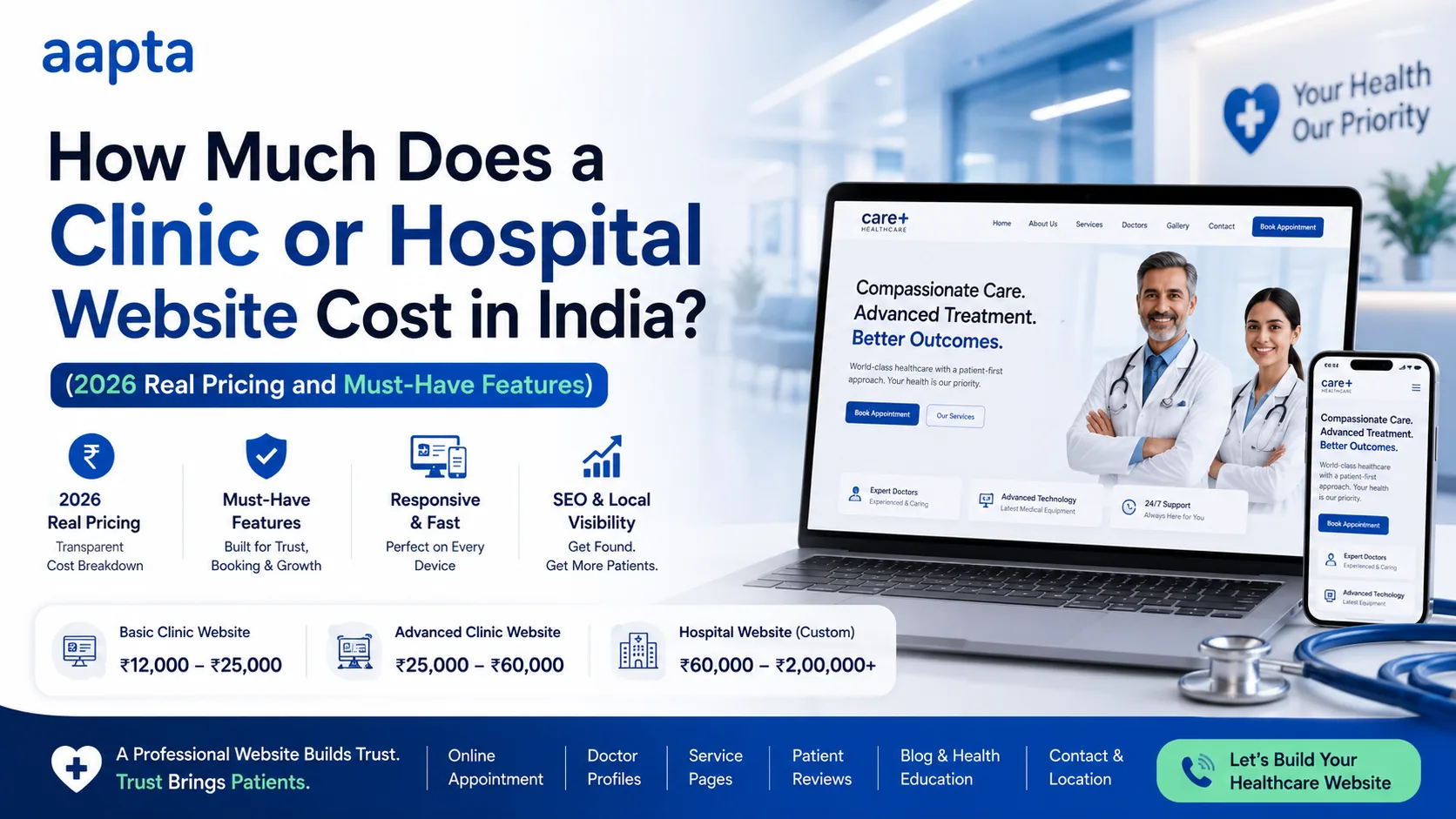
A clinic or hospital website in India in 2026 costs roughly ₹40,000 to ₹80,000 for a single-doctor practice, ₹80,000 to ₹2 lakh for a multi-specialty clinic or polyclinic, and ₹2 lakh to ₹6 lakh or more for a hospital or diagnostic centre, plus ongoing hosting, maintenance, and security. The price is driven by how many doctors and departments you list, whether patients can book appointments online, whether you take payments, and how much compliance you build in. One thing to get straight first: a website is not the same as hospital management software. The website is your public face; the software runs your internal records and billing. The ₹699-to-₹40,000-a-month figures you see are usually the software, not the website. Two compliance points you cannot skip in 2026: the DPDP Act governs patient data on your site, and ABDM/ABHA readiness is becoming the standard. This guide breaks down the real pricing, what drives it, the must-have features, and the ongoing costs nobody quotes upfront.
First, the confusion that costs people money
Before any pricing makes sense, sort out this one thing, because doctors and administrators lose money to it constantly.
A website and hospital management software are two completely different products.
| Website | Hospital management software (HMS / PMS) | |
|---|---|---|
| Who it is for | Patients (public) | Your staff (internal) |
| What it does | Find you, read about doctors and departments, book appointments | Patient records, billing, pharmacy, lab, inventory |
| Typical cost | One-time build + hosting | Monthly subscription per user or bed |
| Example figure | ₹40,000 to ₹6 lakh one-time | ₹699 to ₹40,000+ a month |
The monthly figures you see quoted, ₹699 to ₹40,000 a month, are almost always hospital management software, per 2026 healthcare software pricing in India. That is the internal system that runs appointments, records, and billing for your team. It is not your website. Your website is the public site a patient lands on when they search your name or "orthopaedic clinic near me", and it is usually a one-time build plus modest running costs. This article is about the website. The two connect (a website can hand a booking to the software), but they are budgeted separately, and confusing them is how people either overpay or end up with the wrong thing.
What a clinic or hospital website costs in India (2026)
Here is realistic 2026 pricing for the website itself, by the kind of facility you run. These are professional custom builds, not free templates that look it.
| Facility | What is included | One-time build | Monthly (hosting + care) |
|---|---|---|---|
| Single-doctor clinic / small practice | Homepage, about, services, doctor profile, appointment request, WhatsApp, contact, map | ₹40,000 - ₹80,000 | ₹2,599 - ₹4,500 |
| Multi-specialty clinic / polyclinic | Above + multiple doctors and departments, online booking, online payments, blog | ₹80,000 - ₹2,00,000 | ₹4,500 - ₹8,000 |
| Hospital / diagnostic centre | Above + department pages, patient portal or booking integration, online reports, multilingual, ABDM-ready | ₹2,00,000 - ₹6,00,000+ | ₹8,000 - ₹20,000+ |
Two honest notes on these numbers. First, they are for hand-built, fast, secure sites, not ₹10,000 template jobs that load slowly and get hacked (healthcare is a heavily targeted sector). Second, the ongoing monthly cost is not optional padding. For a healthcare site handling patient enquiries and data, hosting, security, and maintenance are the difference between a site that stays up and safe and one that goes down during a health scare or leaks patient details. We cover why that ongoing care matters in our WordPress security guide for India.
What actually drives the cost
Two clinics can pay very different amounts for a website, and it is not random. These are the factors that move the price.
- Number of doctors and departments. A single-doctor practice is a handful of pages. A hospital with 20 departments and 60 doctors is dozens of structured pages with a system to manage them. More structure, more cost.
- Online appointment booking. A simple "request an appointment" form is cheap. Real-time booking with doctor availability, slots, and confirmation is a proper feature that adds to the build. Booking that also pushes into your management software adds integration work.
- Online payments. Taking consultation fees or deposits online (Razorpay, cards, UPI) adds a payment integration and the testing that goes with it.
- Patient portal or report access. Letting patients log in to see reports or history is the biggest single cost jump, because it means secure accounts and handling health data properly.
- Multilingual. A site in English plus Hindi or a regional language roughly adds to the content and build work.
- Compliance depth. Basic DPDP-compliant data handling is standard. Full ABDM/ABHA integration is a specialist add-on.
- Design and content. Custom photography, doctor bios, and department content take time. Bringing your own content lowers the cost; asking the agency to create it raises it.
What a real quote actually looks like
Ranges are useful, but an itemised breakdown shows where the money goes. Here is roughly how a ₹1.2 lakh website for a multi-specialty clinic (eight doctors, four departments) breaks down, so you can see what you are paying for and where you could trim.
| Line item | What it covers | Approx. |
|---|---|---|
| Design and UX | Homepage plus page templates, built to your brand | ₹25,000 |
| Doctors and departments | A system to manage 8 doctor profiles and 4 department pages | ₹20,000 |
| Appointment booking + WhatsApp | Online request or booking wired to WhatsApp | ₹25,000 |
| Online payments | Razorpay integration for consultation fees | ₹12,000 |
| Blog and SEO setup | Content structure, schema, Google Business Profile linkage | ₹15,000 |
| Security and compliance | SSL, hardening, DPDP-compliant forms, backups | ₹15,000 |
| Content and launch | Content help, photo guidance, testing, handover | ₹8,000 |
| One-time total | ~₹1,20,000 | |
| Hosting and care | Managed hosting, maintenance, monitoring | ~₹5,500/month |
Where can you trim? Bring your own written content and doctor photos and the content line drops. Start with appointment requests instead of live slot booking and that line halves. Where should you not trim? Security and compliance, and the ongoing care. Those are the lines that protect you.
The must-have features for a healthcare website in 2026
Whatever your size, some features are no longer optional if you want the website to actually bring in patients rather than just exist.
- Online appointment booking or request. Patients expect to book without calling. Even a simple request form that reaches your desk instantly beats a phone number nobody answers at lunch. Pairing it with WhatsApp is the highest-converting setup in India, which we detailed in our WhatsApp Business API guide.
- Clear doctor and department profiles. Patients choose a clinic by the doctor. Real photos, qualifications, specialities, and experience build the trust that converts a search into a booking.
- Mobile-first, fast, and accessible. Most patients arrive on a phone, often an older one on a patchy connection. A site that loads in under two seconds and works for elderly or differently-abled users is not a nice-to-have in healthcare, it is the baseline.
- Local SEO and Google Business Profile. "Paediatrician near me" is how patients find you. Your website and your Google Business Profile working together is what wins that search, which we covered in our local maps SEO guide and our Google Business Profile guide.
- Trust signals. Accreditations, patient reviews, timings, insurance and scheme information, and clear contact details. Healthcare is a trust purchase before it is anything else.
- Secure, encrypted, and backed up. SSL everywhere, hardened hosting, and daily backups. A hacked or down healthcare site is a reputational and legal problem, not just an inconvenience.
The compliance you cannot skip
Two regulatory realities shape a healthcare website in India in 2026, and ignoring them is expensive later.
The DPDP Act (patient data). India's Digital Personal Data Protection Act governs how you collect and store personal data, and health data is sensitive. Any form that collects patient details, any booking, any portal, needs consent handling, secure storage, and ideally data kept on Indian infrastructure. This is not optional and it is not just paperwork; it shapes how the site is built.
ABDM and ABHA readiness. The Ayushman Bharat Digital Mission and the ABHA health account are becoming the standard patient identifier in India, and ABDM integration is expected to be mandatory for government-scheme empanelment by 2027. You may not need full ABDM integration on day one, but building the site so it is ABDM-ready avoids an expensive rebuild later. For a hospital or any facility taking government schemes, plan for it now.
The ongoing costs nobody quotes upfront
A website is not a one-time purchase, and for healthcare the ongoing part matters more than most sectors. Budget for:
- Hosting: ₹2,599 to ₹20,000+ a month depending on size and traffic. Healthcare needs reliable, secure hosting, not the cheapest shared plan. We run this on managed cloud hosting so a clinic never has to think about a server.
- Maintenance and security: updates, backups, monitoring, and quick fixes. For a site handling patient data and bookings, this is essential, not optional.
- Domain and email: modest yearly costs for your web address and professional inboxes.
- Content updates: new doctors, new departments, new offers, keeping timings current.
The mistake we see most is a clinic paying for a nice build and then nothing for upkeep, so eighteen months later the site is slow, outdated, insecure, and quietly costing them patients. The build is the start; the care is what keeps it working.
How long does a healthcare website take to build?
Cost and time move together, so plan for both. Realistic timelines in 2026:
- Single-doctor clinic: 2 to 3 weeks from brief to live, assuming you provide content and photos reasonably quickly.
- Multi-specialty clinic: 4 to 6 weeks, because there are more doctors, departments, booking, and payments to build and test.
- Hospital or diagnostic centre: 8 to 12 weeks, sometimes more if a patient portal, ABDM readiness, or multilingual content is involved.
The single biggest cause of delay is not the development, it is content. Doctor bios, department descriptions, photos, timings, and scheme details often sit with a busy medical team that has more urgent work. The clinics that launch on time are the ones that assign one person to gather content early. If you want to move fast, have your doctor list, photos, and department details ready before the build starts, and the timeline above holds.
How not to overpay or underbuild
A few honest guardrails from building healthcare sites for years.
- Do not buy a hospital-sized site for a single-doctor clinic. If you are one doctor, a ₹40,000 to ₹80,000 site with appointment requests and WhatsApp will serve you far better than a ₹3 lakh build you do not need.
- Do not buy a ₹10,000 template for a hospital. For a multi-department facility handling real patient volume and data, a cheap template is a false economy that will fail on speed, security, or compliance.
- Separate the website budget from the software budget. Decide what you need the public site to do, and budget the internal management software as its own line.
- Insist on speed, security, and mobile from day one. In healthcare these are not upgrades, they are the foundation.
- Ask what happens after launch. A quote with no maintenance plan is only half the cost. Find out who keeps it secure and current.
WordPress or custom code for a healthcare website?
This choice quietly decides a lot of your cost, so it is worth a moment. For the large majority of clinics and even many hospitals, a hand-coded WordPress site is the right answer. It is cheaper to build and maintain, easy for your team to update, and has a mature ecosystem for the exact things healthcare sites need: appointment booking, payments, forms, and multilingual content. Built properly, by hand rather than with a bloated page builder, a WordPress healthcare site is fast and secure.
Custom code (a fully bespoke application) only makes sense when you need something WordPress would fight, usually a complex patient portal with deep integration into hospital management software, or a large hospital with unusual requirements. It costs meaningfully more and takes longer, so you should only pay for it when you genuinely need it.
One thing to avoid either way: page builders like Elementor or Divi for a healthcare site. They add weight that slows the site down and expand the security surface, both of which matter more in healthcare than almost anywhere else. A hand-coded build is worth the small premium for the speed and safety it buys. We explain the reasoning in our WordPress security guide, and it applies doubly to any site handling patient data.
Where this leaves you
A clinic or hospital website in India in 2026 is a considered investment, not a commodity, and the right number depends on your size and what you need the site to do: roughly ₹40,000 to ₹80,000 for a single-doctor practice, ₹80,000 to ₹2 lakh for a multi-specialty clinic, and ₹2 lakh upward for a hospital, plus real ongoing care. Get the website-versus-software distinction clear, build the must-have features, take DPDP and ABDM seriously, and budget for upkeep. Do that and the site pays for itself in patients found, booked, and retained.
If you run a clinic or hospital and want a straight, scoped figure for your facility rather than a range, tell us what you need and we will price it honestly, including telling you where you can spend less. You can also see the kind of work we do on our web design and development side.
FAQ
How much does a clinic website cost in India in 2026?
A single-doctor clinic or small practice website costs roughly ₹40,000 to ₹80,000 as a one-time build, plus ₹2,599 to ₹4,500 a month for hosting and maintenance. That covers a professional site with doctor profiles, appointment requests, WhatsApp, and a map. Larger multi-specialty clinics cost more because of multiple doctors, departments, and online booking.
How much does a hospital website cost in India?
A hospital or diagnostic-centre website typically costs ₹2 lakh to ₹6 lakh or more as a one-time build, plus ₹8,000 to ₹20,000+ a month ongoing. The range reflects the number of departments and doctors, a patient portal or booking integration, online reports, multilingual content, and ABDM readiness.
Is a website the same as hospital management software?
No. A website is your public-facing site where patients find you and book. Hospital management software (HMS or PMS) is your internal system for records, billing, pharmacy, and lab. The ₹699-to-₹40,000-a-month figures you see are usually the software. They are budgeted separately, though a website can connect to the software.
Do I need ABDM or ABHA integration on my website?
You may not need full ABDM integration on day one, but you should build the site so it is ABDM-ready, because ABDM is becoming the standard and is expected to be mandatory for government-scheme empanelment by 2027. For any facility taking government schemes, plan for ABDM now to avoid an expensive rebuild later.
What features must a clinic or hospital website have in 2026?
Online appointment booking or request (ideally with WhatsApp), clear doctor and department profiles, a mobile-first and fast build, local SEO with Google Business Profile, trust signals like reviews and accreditations, and strong security with SSL and backups. Patient data handling must comply with the DPDP Act.
What are the ongoing costs after the website is built?
Hosting (₹2,599 to ₹20,000+ a month by size), maintenance and security (updates, backups, monitoring), domain and email (modest yearly costs), and content updates for new doctors or departments. For healthcare, ongoing security and maintenance are essential, not optional, given patient data and uptime.
Why is a healthcare website more expensive than a normal business site?
Because of structure and compliance. Multiple doctors and departments, appointment booking, secure patient-data handling under the DPDP Act, ABDM readiness, and higher security expectations all add work that a simple business brochure site does not have. You are paying for trust, security, and function, not just pages.
Can I take payments and bookings directly on the website?
Yes. You can add online appointment booking with doctor availability and online payment for consultation fees or deposits via Razorpay, cards, or UPI. Both add to the build cost, and booking that pushes into your management software adds integration work, but for many clinics they pay for themselves quickly in convenience and reduced no-shows.
Related guides
- The restaurant industry in India: an overview
- A free website for NGOs: introducing Aapta for Good
- WordPress development cost in India
- Add WhatsApp chat and automation to your website
About the author
Dharmendra Asimi is the founder of Aapta Solutions, established in 2007 and now serving SMBs and growing brands across India, the United States, and the United Kingdom. Over the past twenty years he has shipped WordPress builds, e-commerce stores, managed cloud hosting, and SEO programmes for hundreds of businesses (from single-product Shopify stores to multi-region WordPress estates handling Black Friday peaks).
He is the creator of Aapta GEO (a free 30-second AI-readiness scan) and Aapta SEO AI (a monthly tracker for how ChatGPT, Claude, Perplexity, and Gemini cite your content). His writing on web engineering and AI-search visibility is read by founders, marketing teams, and SEO managers across three time zones.
Areas of expertise: WordPress development at scale · managed cloud hosting (AWS, GCP, Azure, Cloudflare) · technical SEO · Generative Engine Optimization (GEO) · AI-search citation tracking · ecommerce architecture across WooCommerce, SureCart, Shopify, and Magento · Site Reliability Engineering for content platforms · brand strategy and visual identity.
Connect: LinkedIn · X · Instagram · personal site · About page · Contact Aapta
This article is maintained as part of Aapta's content quality programme. If any data point looks stale or incorrect next time you read this, tell us and we will verify and update within 48 hours.
Need help with this?
Our team has 19+ years of experience and can help you implement everything discussed in this article.
Book a Discovery Call