
The short answer
llms.txt is a simple markdown file you place at your domain root (yoursite.com/llms.txt) that lists your most important pages with short descriptions, so AI tools can find and understand your content quickly. Here is the honest part most guides skip: in 2026, having an llms.txt file does not measurably improve your chances of being cited by ChatGPT, Perplexity, Gemini, or Google's AI Overviews. Google has publicly said it does not use llms.txt and has no plans to, comparing it to the old keywords meta tag, and the major AI answer engines do not request the file at meaningful volume. Where llms.txt genuinely helps is with AI agents and developer tools: Cursor, the OpenAI Agents SDK, Anthropic's agent guidance, and Chrome's new Lighthouse agentic-browsing audit all use or check for it, and it is cheap future-proofing as the standard matures. So yes, add one, it takes thirty minutes and cannot hurt, but do not expect it to move your AI-search visibility. That comes from Generative Engine Optimization, which is a different discipline. This guide explains what llms.txt is, what the evidence actually shows, where it helps, and how to create one.
What is llms.txt, exactly?
llms.txt is a proposed standard, introduced in September 2024, for telling large language models which parts of your site matter and how they fit together. It is a single markdown file placed at your domain root, reachable at https://yoursite.com/llms.txt, just like robots.txt lives at /robots.txt.
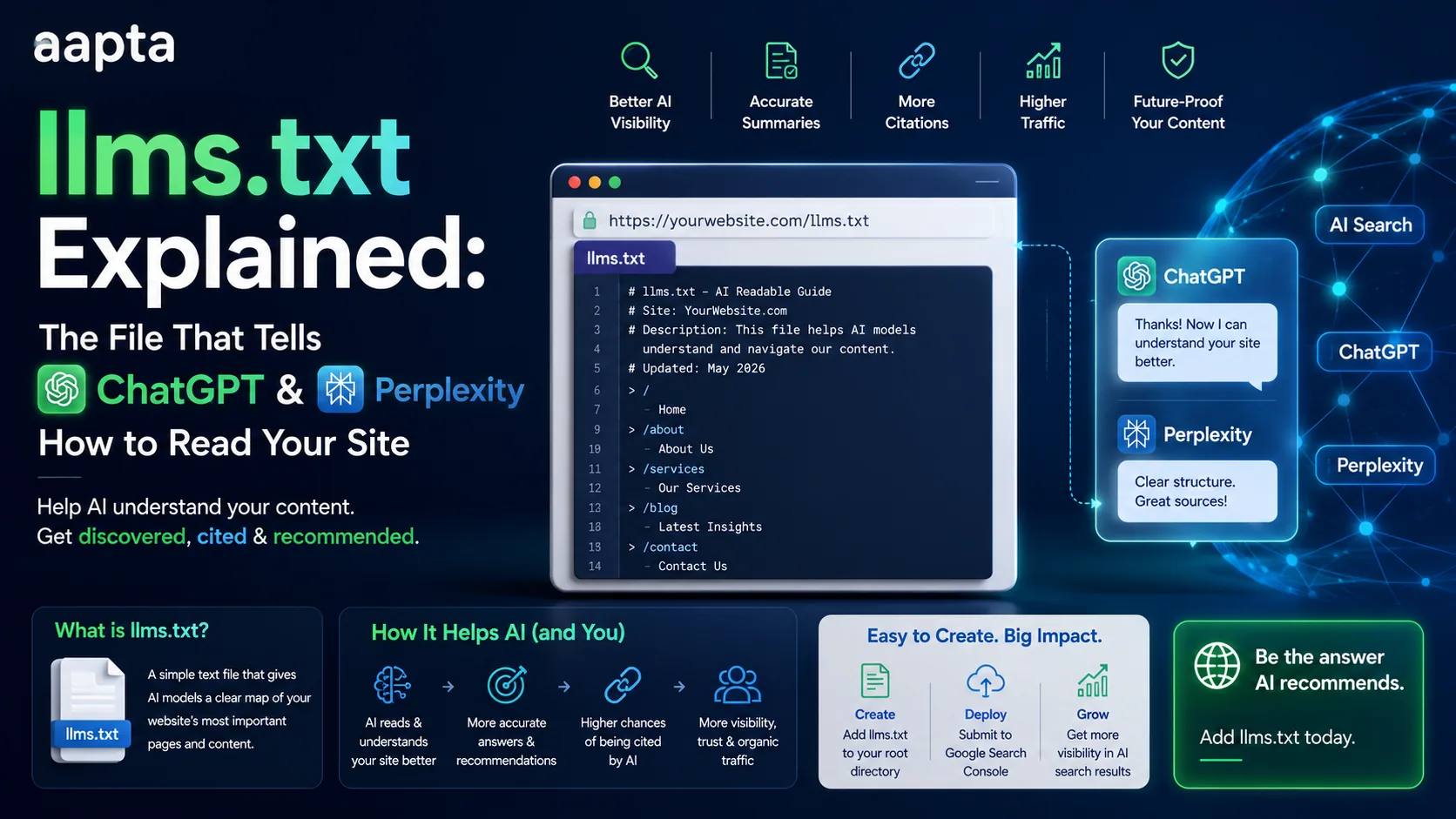
The idea is reasonable. A modern website is a mess of navigation, scripts, cookie banners, and boilerplate. An llms.txt file cuts through that by handing an AI a clean, curated map: here is who we are, here are our most important pages, here is what each one covers. The format is deliberately simple:
- An H1 with your brand or project name.
- A blockquote with a one or two sentence summary of what you do.
- Markdown sections that group links by category (Documentation, Key Pages, Optional).
- Bullet lists where each link has a short description.
There is also a companion file, llms-full.txt, which contains your entire content as one long markdown document for deep ingestion. More on that, and its risks, below.
It sounds like an obvious win. The question is whether the AI engines you care about actually use it. This is where the honest answer diverges sharply from the marketing.
The honest truth: does llms.txt actually work in 2026?
If you only remember one section, make it this one, because a lot of confident advice online is simply wrong.
No major consumer AI answer engine has confirmed it uses llms.txt to answer questions. That includes ChatGPT search, Perplexity, Google AI Overviews, Gemini, Copilot, and Claude.ai search. Multiple independent analyses in 2026 found that having an llms.txt file does not measurably improve your odds of being cited, and that ClaudeBot, Google-Extended, and PerplexityBot do not request the file at meaningful volume.
Google has explicitly rejected it. In July 2025, Google's Gary Illyes confirmed Google does not support llms.txt and is not planning to, and John Mueller compared it to the discredited keywords meta tag. Google's May 2026 AI-optimisation guidance tells site owners plainly that llms.txt is not needed for AI Overviews, AI Mode, or any other generative AI search feature.
So why does everyone insist you need one? Three reasons. First, it is a new, tidy, technical-sounding tactic, and the SEO industry loves a new tactic. Second, the big AI answers still often cite sites that happen to have an llms.txt, which looks like correlation but is really just that well-run sites tend to do both. Third, a few tools genuinely do use it, and that nuance gets flattened into "AI uses llms.txt."
The evidence-based position for 2026: llms.txt does not currently drive your visibility in AI search results. If someone is selling you llms.txt as the key to getting cited by ChatGPT, they are overselling it, or as some honest guides put it, confusing what it does with what it doesn't.
So why bother? Where llms.txt genuinely helps
Not consumer AI search. But there is a real and growing use case, and it is worth understanding because it is where the standard is actually gaining traction.
- AI coding and IDE agents use it. Tools like Cursor, Continue, Cline, and Aider increasingly look for llms.txt when you point them at a documentation site, so the agent can read your docs cleanly instead of scraping cluttered HTML.
- Anthropic and OpenAI reference it for agents. Anthropic recommends llms.txt in its guidance on writing for agents, and OpenAI uses it in contexts like the Agents SDK and the Agentic Commerce Protocol (codersera, 2026).
- Chrome now audits for it. Chrome's Lighthouse 13.3, released in early May 2026, added an Agentic Browsing audit category that checks whether your site provides the file. So it is becoming a measurable "best practice" box even where it does not drive citations.
- Serious companies publish one. Anthropic, Stripe, Cursor, Cloudflare, Vercel, Mintlify, and Supabase all ship an llms.txt, and about 10% of websites now have one, concentrated in SaaS, publishing, and tech.
Put together, the honest case for llms.txt in 2026 is not "get cited by ChatGPT." It is: make your site legible to the AI agents that are starting to browse and act on the web, tick a growing best-practice box, and buy cheap insurance in case the consumer engines do adopt it later. For a documentation-heavy or developer-facing business, that case is genuinely strong. For a local restaurant, it is close to irrelevant today.
How to create an llms.txt file (with an example)
The good news: it is trivial, needs no special tools, and takes about thirty minutes. Open a text editor, write structured markdown, and save it as llms.txt at your site root. Here is a clean template for a typical business site:
# Aapta Solutions

> Aapta Solutions builds and maintains WordPress websites, managed cloud
> hosting, and SEO/GEO programmes for SMBs across India, the US, and the UK.

## Key pages
- [Services](https://www.aapta.in/services): What we do and who we serve
- [WordPress](https://www.aapta.in/wordpress): WordPress development and care plans
- [Cloud hosting](https://www.aapta.in/services/cloud-hosting): Managed hosting plans
- [Contact](https://www.aapta.in/contact): Get a quote or ask a question

## Guides
- [GEO in 2026](https://www.aapta.in/blog/generative-engine-optimization-geo-2026-ai-readiness-guide): How to get cited by AI engines
- [WordPress SEO for India](https://www.aapta.in/blog/the-complete-guide-to-wordpress-seo-in-india-2026): Practical SEO guide

## Optional
- [About](https://www.aapta.in/about): Company background and team
A few rules that separate a useful file from a useless one:
- Curate, do not dump. The point is to highlight your best, most representative pages, not to list all 200 URLs. If everything is important, nothing is.
- Write real descriptions. Each link's one-line description is doing the work; make it specific, not "Learn more."
- Keep it current. A stale llms.txt pointing at dead pages is worse than none.
- Validate it. Run it through an llms.txt validator to confirm the structure parses.
That is the whole job. It is a genuinely quick win in the "cannot hurt, might help later" category.
How to add llms.txt to WordPress or Next.js
Because the file just needs to live at your domain root, adding it is quick on any stack.
On WordPress: the simplest route is to drop a plain llms.txt file into your site's root directory via FTP or your host's file manager, right alongside robots.txt. Several SEO plugins (including newer versions of Rank Math and dedicated llms.txt plugins) can now generate and serve one from your pages, which keeps it updated automatically as you publish. If you use a plugin, review what it outputs, because auto-generators tend to dump every page rather than curate your best.
On Next.js or a static site: place llms.txt in your public/ directory and it is served at /llms.txt automatically, exactly like any static asset. For a site that changes often, you can generate it dynamically from your content at build time, the same way a sitemap is generated, so it always reflects your current pages.
On any stack: confirm it is live by visiting yoursite.com/llms.txt in a browser and checking that it returns plain markdown with a 200 status, not a 404 or your site's HTML shell. Then run it through a validator to confirm the structure parses. That is the entire deployment.
Whichever stack you are on, the file is the easy part. The judgement is in what you choose to include: curate for your best, most representative pages, and keep it honest.
llms.txt vs llms-full.txt: mind the tradeoff
llms-full.txt is the companion format: instead of linking to your pages, it contains your entire site content as one long markdown file for deep AI ingestion. It sounds more thorough, and for open documentation it can be.
But there is a real tradeoff for most businesses: an llms-full.txt hands your complete content to anyone who wants a clean, effort-free scrape. If your business depends on people actually visiting your pages (ad revenue, lead capture, gated depth), publishing your whole site as one tidy markdown file for machines to swallow whole is not obviously in your interest. For a docs site that wants maximum ingestion, llms-full.txt makes sense. For a lead-gen business site, the lighter llms.txt (links, not full content) is usually the smarter choice.
What actually gets you cited by AI (the thing llms.txt is not)
Here is the part that matters most, because it is where your effort should actually go. If your goal is to be recommended and cited when someone asks ChatGPT, Gemini, or Perplexity a question, llms.txt is not the lever. The lever is Generative Engine Optimization (GEO): structuring your content so AI engines can extract clean answers from it, earning mentions on the third-party sources they trust, and keeping your entity record consistent.
That is a genuinely different discipline, and I have written it up in depth:
- The full picture of how the acronyms fit together, in our SEO vs GEO vs AEO field guide.
- The focused how-to on getting cited by ChatGPT, Claude, and Perplexity.
- Why your site can rank on Google but stay invisible in ChatGPT, and how to fix it.
- What actually earns citations, from the analysis of 9.5 million AI citations.
- And how to check whether AI engines are already recommending you.
The one-line version: add llms.txt because it is cheap and agent-friendly, but invest your real time in GEO, because that is what moves citations. Run a free Aapta GEO scan to see where your site stands across the six categories AI engines actually weigh.
Common myths about llms.txt, corrected
Because the hype has outrun the evidence, here are the claims you will hear and what is actually true.
Myth: "llms.txt gets you cited by ChatGPT and Perplexity." Reality: no consumer AI answer engine has confirmed using it, and studies show no measurable citation lift in 2026. Citations come from GEO, not from this file.
Myth: "Google reads llms.txt to understand your site for AI Overviews." Reality: Google has said the opposite, on the record, more than once. Its 2026 guidance explicitly states the file is not needed for any of its generative search features.
Myth: "If you don't add one, AI can't read your site." Reality: AI crawlers read your normal HTML pages perfectly well. llms.txt is a convenience layer for agents, not a gate. A site with no llms.txt is fully readable.
Myth: "It's an official web standard like robots.txt." Reality: robots.txt is a long-established convention that crawlers honour; llms.txt is a 2024 proposal that no major engine has formally adopted. Treat it as a promising convention, not a rule.
Myth: "You need to pay an agency to optimise your llms.txt." Reality: a good llms.txt is a curated list of your best pages with descriptions. It is a thirty-minute in-house job. Anyone charging a retainer to "optimise" it is selling you a non-service.
Myth: "More is better, so publish llms-full.txt with everything." Reality: dumping your entire site as one markdown file mostly helps scrapers take your content without a visit. Curate, do not dump.
The pattern is consistent: llms.txt is a real, useful, low-effort file for the agentic web, wrapped in claims about consumer AI search that the evidence does not support. Hold both truths at once and you will make the right call.
Should you add an llms.txt file? A straight recommendation
- You run a documentation-heavy, developer-facing, or SaaS product? Yes, add both llms.txt and consider llms-full.txt. Your audience uses the exact AI agents that consume these files. It is a real best practice for you.
- You run a normal business, local service, or lead-gen site? Add a simple llms.txt. It takes thirty minutes, it cannot hurt, it ticks the Lighthouse box, and it future-proofs you. Then forget about it and spend your energy on GEO and content.
- You were about to pay someone a lot of money to "optimise your llms.txt for AI citations"? Do not. That is not a real service in 2026. A basic file is a thirty-minute job, and the citation lift they are promising does not exist yet.
llms.txt is a sensible, low-cost thing to have. It is just not the AI-visibility silver bullet it is often sold as. Add it, keep it honest, and put your real effort where the evidence points. In a year, if the consumer engines do start consuming it, you will already have one in place; and if they never do, you will have spent thirty minutes, not a monthly retainer chasing a benefit that was never there.
Frequently asked questions
Does ChatGPT or Perplexity actually read my llms.txt file?
Not in any confirmed, meaningful way as of 2026. No major consumer AI answer engine (ChatGPT search, Perplexity, Gemini, Copilot, or Claude.ai) has confirmed it uses llms.txt to answer questions, and analyses show the file does not measurably improve your odds of being cited. The tools that do use it are AI coding and browsing agents, not the consumer answer engines most people are trying to rank in.
Does Google use llms.txt?
No. Google has publicly stated it does not support llms.txt and has no plans to. Gary Illyes confirmed this, John Mueller compared it to the old keywords meta tag, and Google's 2026 AI-optimisation guidance explicitly says llms.txt is not needed for AI Overviews, AI Mode, or any generative search feature. If your goal is Google's AI surfaces, llms.txt is not the tool.
If it does not drive citations, why add llms.txt at all?
Because it is cheap and increasingly useful for AI agents. Coding agents like Cursor and Aider use it, Anthropic and OpenAI reference it for their agent tooling, and Chrome's Lighthouse now audits for it. It is a thirty-minute job that makes your site legible to the agentic web and future-proofs you if the consumer engines adopt it later. Just do not expect it to lift your AI-search visibility today.
How do I create an llms.txt file?
Write a markdown file with an H1 of your brand name, a blockquote summary of what you do, and sections grouping your key links with a short description each, then save it as llms.txt at your domain root (yoursite.com/llms.txt). It needs no special tools, just a text editor. Curate your best pages rather than dumping every URL, write specific descriptions, and validate the structure before publishing.
What is the difference between llms.txt and llms-full.txt?
llms.txt lists your important pages with descriptions (a curated map), while llms-full.txt contains your entire site content as one long markdown document for deep ingestion. llms-full.txt is useful for open documentation, but it hands your whole content to anyone who wants an effortless scrape, which is a real downside for lead-gen or ad-supported sites. For most businesses, the lighter llms.txt is the safer choice.
Will llms.txt help my local business get found by AI?
Barely, today. For a local restaurant, clinic, or service business, llms.txt is close to irrelevant to how customers find you through AI right now. Your AI visibility comes from GEO, a strong Google Business Profile, structured content, and third-party mentions, not from a file the consumer engines do not consume. Add llms.txt if you like since it is free, but put your effort into GEO and local search.
What should I do instead of relying on llms.txt for AI visibility?
Invest in Generative Engine Optimization: structure your content so AI engines can extract clean answers, earn mentions on the sources they trust, keep your entity record consistent, and publish genuinely useful, specific content. That is what actually moves citations in ChatGPT, Gemini, and Perplexity. Treat llms.txt as a cheap extra, not the strategy.
About the author
Dharmendra Asimi is the founder of Aapta Solutions, established in 2007 and now serving SMBs and growing brands across India, the United States, and the United Kingdom. Over the past twenty years he has shipped WordPress builds, e-commerce stores, managed cloud hosting, and SEO programmes for hundreds of businesses (from single-product Shopify stores to multi-region WordPress estates handling Black Friday peaks).
He is the creator of Aapta GEO (a free 30-second AI-readiness scan) and Aapta SEO AI (a monthly tracker for how ChatGPT, Claude, Perplexity, and Gemini cite your content). His writing on web engineering and AI-search visibility is read by founders, marketing teams, and SEO managers across three time zones.
Areas of expertise: WordPress development at scale · managed cloud hosting (AWS, GCP, Azure, Cloudflare) · technical SEO · Generative Engine Optimization (GEO) · AI-search citation tracking · ecommerce architecture across WooCommerce, SureCart, Shopify, and Magento · Site Reliability Engineering for content platforms · brand strategy and visual identity.
Connect: LinkedIn · X · Instagram · personal site · About page · Contact Aapta
This article is maintained as part of Aapta's content quality programme. If any data point looks stale or incorrect next time you read this, tell us and we will verify and update within 48 hours.
Need help with this?
Our team has 19+ years of experience and can help you implement everything discussed in this article.
Book a Discovery Call