
The short answer
Yes, real estate agents in India need their own website in 2026, and portal listings alone will not cut it. 78% of Indian homebuyers now start their property search online, up from 68% a year earlier (JLL, 2025), yet portals like 99acres and MagicBricks sell the same enquiry to as many as five agents, so a paid lead gives you roughly a one-in-five chance of the deal at best. Your own website does three things portals cannot: it captures leads that belong only to you, it displays your mandatory RERA registration number (required by law on all marketing), and it lets you rank locally and in AI search for the neighbourhoods you actually work. A professional agent website in India costs roughly ₹25,000 to ₹1,50,000 depending on scope, and the lead-gen setup around it (local SEO, Google Ads, WhatsApp capture, and locality landing pages) is what turns it from a brochure into a pipeline. Here is exactly what to build, what it costs, and how to make it generate leads.
Do real estate agents in India even need a website?
The instinct many agents have is understandable: "The portals already have all the buyers. Why build my own site?" The answer is in how buyers behave and how portals make their money.
India's real estate market is worth around USD 585 billion in 2026 (Mordor Intelligence) and heading toward USD 970 billion by 2030 (IBEF), with residential making up roughly 78% of it. The sector is on track to contribute 15.5% of India's GDP by 2047, up from 7.3% today. That growth is happening online first. Technology-led property search jumped to 78% of buyers in 2025 from 68% in 2024 (JLL). Buyers research localities, compare projects, and shortlist agents from their phones before they ever pick one to call.
The catch is that when they research on a portal, they are not researching you. They are researching a listing. And the portal's business model depends on selling the resulting enquiry to as many agents as it can.
Why portal listings alone are not enough
Portals are useful. They are also structurally designed to keep you dependent and interchangeable. Three realities every agent should price in:
- Leads are shared, not exclusive. A single enquiry from a portal is commonly sold to up to five agents at once, which means your paid lead is a one-in-five chance of connecting, at best (Optimized Growth, 2026). You are racing four competitors to call the same person first.
- It is not cheap. Cost per lead runs ₹300 to ₹2,000 depending on city and segment, and a small agency of three to five agents typically spends ₹25,000 to ₹75,000 a month across portals and ads just to stay visible (Realatic, 2026).
- You never own the relationship. The buyer's trust, if any, attaches to the portal brand (99acres drew roughly 13.3 million monthly visits and MagicBricks 12.1 million in late 2025), not to you. Stop paying and you disappear.
Compare that to a website you own. A lead from your site is yours alone. There is no competitor being handed the same phone number. The buyer arrived because they searched for your area or your name, saw your listings and reviews, and chose to contact you specifically. That is a fundamentally warmer, cheaper, and more defensible lead. This is the same "rented platform versus owned asset" argument I made in do you still need a website in 2026, and it applies to property harder than almost any other business.
The RERA angle: your website is a compliance surface too
There is a legal dimension agents often miss. Under Section 9 of the RERA Act, 2016, registration is mandatory for every real estate agent and broker facilitating property transactions in India. Registration fees run ₹10,000 to ₹25,000 for individuals and up to ₹2,00,000 for firms, and the registration is valid for five years.
Crucially, your RERA registration number must be displayed on all advertisements and marketing materials, and in 2026 your website is marketing material. Operating or advertising without a valid, displayed registration can attract penalties of ₹10,000 per day of default, up to 5% of the property cost, under Section 59.
A properly built agent website turns this obligation into a trust signal. A clear RERA number in your footer and on your listings tells a cautious buyer you are a registered, accountable professional, not an anonymous number on a classifieds page. Compliance and credibility become the same thing.
What features a real estate agent website actually needs
Not every agent needs an enterprise portal clone. But the following features separate a site that generates leads from a digital business card. Here is the priority list.
| Feature | Why it matters | Priority |
|---|---|---|
| Property listings with photos, price, location, status | The core reason buyers visit. Filterable by budget, BHK, locality | Essential |
| WhatsApp click-to-chat on every listing | India's default contact channel. One tap opens a pre-filled chat | Essential |
| Lead capture forms with instant routing | Enquiries hit your phone and email the moment they submit | Essential |
| RERA number display | Legal requirement plus a trust signal | Essential |
| Mobile-first, fast-loading pages | Most buyers are on a phone on mobile data | Essential |
| Locality / neighbourhood landing pages | Rank for "2 BHK in [area]" searches you actually serve | High |
| Google Business Profile + reviews embed | Local trust and map visibility | High |
| Virtual tours, video, and drone footage | Listings with drone footage get 52% more views and sell 25% faster (2024 data) | High |
| EMI / home-loan calculator | Keeps buyers on-site and qualifies intent | Medium |
| IDX / property search with saved searches | For agencies with large inventories | Medium |
| Blog / area guides for SEO and AI search | Ranks and gets cited when buyers ask AI about a locality | Medium |
| Chatbot for after-hours enquiries | Chatbots handled 35% of portal queries in 2024, rising to 45% in 2025 | Optional |
The essentials are non-negotiable even on the smallest budget. The high-priority items are where lead volume actually comes from. The rest you add as your inventory and budget grow.
How much does a real estate agent website cost in India?
Costs vary by scope, but here are the realistic 2026 bands, in the same spirit as our clinic and hospital website cost breakdown and the broader WordPress development cost guide.
| Tier | Cost (one-time) | What you get |
|---|---|---|
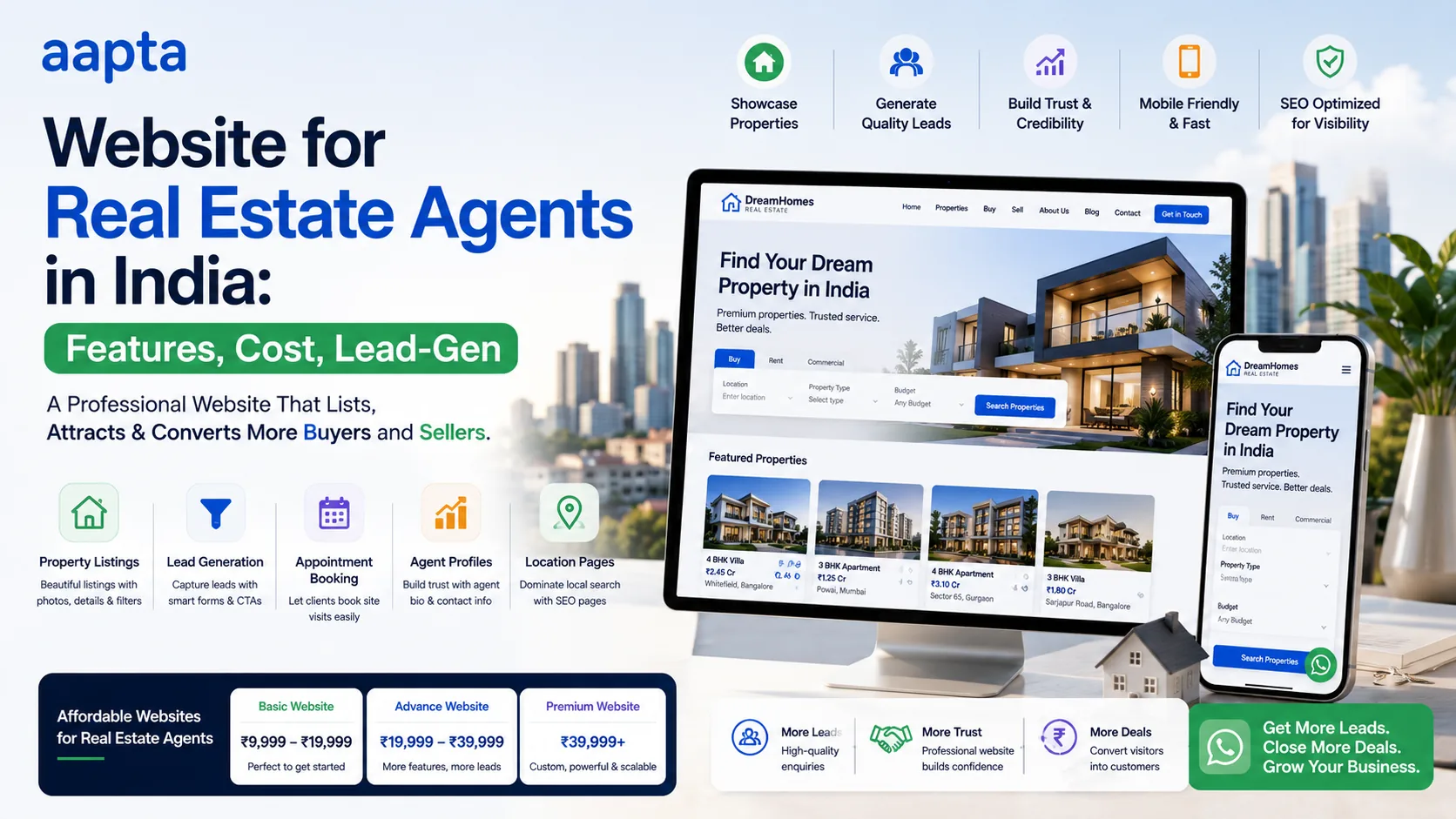
| Starter | ₹25,000 to ₹50,000 | 5 to 7 pages, listings showcase, WhatsApp chat, lead form, RERA display, mobile-first, basic on-page SEO |
| Professional | ₹60,000 to ₹1,20,000 | Everything in Starter plus property search/filters, 5 to 10 locality landing pages, video and virtual-tour embeds, CRM lead routing, blog, Google Ads landing pages |
| Premium | ₹1,50,000 and up | Everything in Professional plus IDX integration, map-based search, buyer accounts and saved searches, multi-agent support, automation, and advanced SEO/GEO |
On top of the build, budget for running costs: hosting and domain (roughly ₹5,000 to ₹15,000 a year), and optionally a maintenance plan so listings, security, and speed stay handled. A mistake I see often is agents spending ₹50,000 a month on portals for years while refusing a one-time ₹60,000 site that would cut that dependency. Over a year, the portal spend is ₹6,00,000. The website is a rounding error against it.
How to actually generate leads from the site
A website with no traffic strategy is a brochure. Here is the lead-gen system I would set up for a real estate agent in India, in order.
- Build locality landing pages, one per area you work. A page titled "2 & 3 BHK Flats in Whitefield, Bangalore" with current listings, a locality guide, and a lead form will rank for exactly the searches serious buyers make. This is the single biggest organic lead source for agents. Tie it in with the tactics in local maps SEO with and without a website.
- Claim and optimise your Google Business Profile. Reviews, photos, and accurate service areas put you on the map (literally) for "property dealer near me". Our Google Business Profile guide covers the full setup.
- Run Google Ads to dedicated landing pages, not your homepage. Someone searching "3 BHK for sale in Kharadi" should land on a Kharadi page, not a generic home page. Done right, ads to a real website cost less and convert better, which I break down in Google Ads with vs without a website.
- Put WhatsApp capture on everything. A WhatsApp button on every listing, plus automated first replies, catches the buyers who will message but never fill a form. Here is how to add WhatsApp chat and automation without a big BSP bill.
- Publish area guides and answer buyer questions. "Is Sarjapur Road a good investment in 2026?" style content ranks on Google and gets cited when buyers ask AI engines about a locality. This is where being present in AI search, or GEO for local businesses, starts paying off.
- Add lead magnets. A downloadable "Whitefield price trends 2026" PDF or a free valuation request converts researchers into contacts you can follow up with.
- Retarget your visitors. Most buyers do not enquire on the first visit. A remarketing pixel lets you show ads to people who browsed your listings and left, at a fraction of cold-lead cost.
The compounding effect matters. Portal spend buys you a shared lead today and nothing tomorrow. This system builds locality pages that rank for years, a review profile that grows, and a remarketing pool that fills every month. The website spend appreciates. The portal spend evaporates.
Website vs portals: where your money works hardest
The honest answer is that most successful agents use both, but with the ratio inverted from how they start. Here is the contrast.
| Factor | Property portals | Your own website |
|---|---|---|
| Lead exclusivity | Shared with up to 5 agents | 100% yours |
| Cost model | Pay per lead, forever | One-time build, then low running cost |
| Who owns the buyer trust | The portal brand | You |
| Local search ranking | You compete inside their platform | You rank on Google and AI for your areas |
| RERA compliance display | Limited | Full control, builds trust |
| What remains if you stop paying | Nothing | The whole asset keeps working |
| Best use | Topping up volume, new areas | Your core, owned pipeline |
Portals are a fine way to top up volume, especially when entering a new area. But building your business entirely on rented, shared leads is the most expensive way to grow. The agents who win over five years are the ones who use portals as a supplement to an owned website, not as a substitute for one.
A realistic first 90 days
If you are starting from zero, here is a sane order of operations:
- Weeks 1 to 3: Build a Professional-tier site with your key listings, WhatsApp capture, RERA number, and three to five locality pages for your strongest areas.
- Weeks 3 to 5: Claim and fill out your Google Business Profile, gather your first 10 reviews from past clients, and connect the site's lead forms to your phone and a simple CRM.
- Weeks 5 to 8: Launch a small Google Ads campaign (₹15,000 to ₹30,000/month) pointing at locality landing pages, with conversion tracking and remarketing switched on from day one.
- Weeks 8 to 12: Publish two area guides, add virtual tours to your top listings, and review which localities and keywords are actually producing enquiries. Double down on those.
By the end of the quarter you have an owned pipeline running in parallel to your portal spend, and the data to start shifting budget from shared leads to leads you own.
Common mistakes real estate agents make with their website
Building the site is the easy part. Here are the errors that turn an agent website into a dead brochure, and how to avoid each one.
- Treating it as a digital business card. A homepage with a bio and a phone number generates nothing. Leads come from listings, locality pages, and a clear reason to enquire, not a static "About me".
- Ignoring speed on mobile. Most Indian buyers browse on a phone on mobile data. A site that takes six seconds to load loses them before the first photo appears. Fast, mobile-first pages are not optional, which is why we treat speed optimisation as core, not cosmetic.
- No follow-up system. An enquiry that sits unanswered for two hours is usually gone, because the buyer has already called the next agent. Route every lead to your phone instantly and reply, ideally on WhatsApp, within minutes.
- Publishing listings once and never updating. Stale "sold" listings and dead links destroy trust and hurt rankings. Property data has to stay current to be worth anything.
- Copying portal listing text verbatim. Duplicated descriptions do not rank on Google. Original locality guides and honest write-ups are what earn search visibility and AI citations.
- Skipping analytics. If you cannot see which localities and keywords produce enquiries, you cannot shift budget toward what works. Install analytics and conversion tracking from day one.
The through-line is simple: a real estate website earns its keep only when it is fast, current, and wired to convert and follow up. India's property buyers are increasingly digital, with over 55% of metro transactions using digital contracts in 2024 and that figure expected to cross 70% in 2025 (Destino Landbase, 2025). The agents who treat their site as live infrastructure, not a one-time brochure, are the ones it pays back.
Frequently asked questions
Do real estate agents in India really need a website if they are on 99acres and MagicBricks?
Yes. Portals give you visibility but sell the same enquiry to as many as five agents, so your paid lead is roughly a one-in-five chance at best. A website gives you leads that are exclusively yours, lets you rank for the localities you serve, displays your RERA number for trust, and keeps working after you stop paying. Most successful agents use portals to top up volume and a website as their owned core pipeline.
How much does a real estate agent website cost in India in 2026?
A starter site runs ₹25,000 to ₹50,000, a professional site with property search, locality pages, and lead routing runs ₹60,000 to ₹1,20,000, and a premium site with IDX, map search, and buyer accounts starts around ₹1,50,000. Add roughly ₹5,000 to ₹15,000 a year for hosting and domain. Against a typical portal spend of ₹25,000 to ₹75,000 a month, a one-time website pays for itself quickly.
Is a RERA number required on a real estate agent's website?
Yes. Under the RERA Act, 2016, agent registration is mandatory, and your registration number must be displayed on all advertisements and marketing materials, which includes your website. Non-compliance can attract penalties of ₹10,000 per day, up to 5% of the property cost, under Section 59. Displaying your RERA number is both a legal requirement and a strong trust signal for cautious buyers.
What is the best way to generate real estate leads in India?
Locality landing pages are the highest-return organic source: a page targeting "3 BHK in [area]" ranks for exactly what serious buyers search. Combine that with an optimised Google Business Profile, Google Ads to dedicated landing pages, WhatsApp capture on every listing, area-guide content for SEO and AI search, and remarketing to previous visitors. This system produces leads you own, unlike shared portal enquiries.
Should I build my real estate website on WordPress?
For most Indian agents, yes. WordPress handles property listings, locality pages, WhatsApp integration, and lead forms well, is affordable to maintain, and gives you full ownership of your data and SEO. For very large inventories you may want a dedicated IDX or a custom build. The right choice depends on your listing volume and budget, which we are happy to advise on.
Do buyers actually use video and virtual tours?
Increasingly, yes. Listings with drone footage get around 52% more views and sell about 25% faster (2024 industry data), and VR/AR reportedly lifted buyer engagement by 46% in 2024. Video and virtual tours qualify buyers before a site visit, saving you time on tyre-kickers and speeding up serious deals. They are a high-priority feature for anything above the starter tier.
How long does it take to see leads from a new agent website?
Google Ads to locality landing pages can produce enquiries within days of launch. Organic local SEO from locality pages and your Google Business Profile typically starts building over 6 to 12 weeks and compounds from there. A realistic expectation is a small flow of paid leads in the first month and a growing base of owned organic leads by the end of the first quarter.
About the author
Dharmendra Asimi is the founder of Aapta Solutions, established in 2007 and now serving SMBs and growing brands across India, the United States, and the United Kingdom. Over the past twenty years he has shipped WordPress builds, e-commerce stores, managed cloud hosting, and SEO programmes for hundreds of businesses (from single-product Shopify stores to multi-region WordPress estates handling Black Friday peaks).
He is the creator of Aapta GEO (a free 30-second AI-readiness scan) and Aapta SEO AI (a monthly tracker for how ChatGPT, Claude, Perplexity, and Gemini cite your content). His writing on web engineering and AI-search visibility is read by founders, marketing teams, and SEO managers across three time zones.
Areas of expertise: WordPress development at scale · managed cloud hosting (AWS, GCP, Azure, Cloudflare) · technical SEO · Generative Engine Optimization (GEO) · AI-search citation tracking · ecommerce architecture across WooCommerce, SureCart, Shopify, and Magento · Site Reliability Engineering for content platforms · brand strategy and visual identity.
Connect: LinkedIn · X · Instagram · personal site · About page · Contact Aapta
This article is maintained as part of Aapta's content quality programme. If any data point looks stale or incorrect next time you read this, tell us and we will verify and update within 48 hours.
Need help with this?
Our team has 19+ years of experience and can help you implement everything discussed in this article.
Book a Discovery Call