
The short answer
Swiggy and Zomato are excellent for discovery, but they take an effective 25 to 35% of every order once you add base commission (17 to 28%), the per-order platform fee, GST charged on the commission itself, and mandatory discounts. A restaurant website with its own online ordering costs roughly ₹40,000 to ₹1,50,000 to build in India, then ₹2,000 to ₹3,000 a month plus small payment-gateway fees to run, and it lets you keep the margin and own the customer relationship. This matters because direct restaurant-to-consumer ordering is now around 63% of India's delivery segment, and the online food delivery market is worth about USD 61 billion and growing near 27% a year. The move is not to quit the aggregators, it is to stop routing your repeat customers, the ones who already know you, through a 30% toll booth. This guide breaks down the real costs, compares building your own site against platforms like DotPe and Petpooja against staying aggregator-only, and covers the features that actually convert diners into direct orders.
The real cost of Swiggy and Zomato
Most owners know the commission is high. Few have done the full arithmetic, and the full arithmetic is worse than the headline.
The base commission runs 17 to 28% for Zomato and 17 to 25% for Swiggy depending on city, cuisine, outlet age, and how hard you negotiated (Petpooja, 2026). But that is only the start. On top of it sit a per-order platform fee (around ₹17.58), 18% GST charged on the commission amount itself, and the "mandatory" discounts the platforms push you into to stay visible. Add it all up and the effective deduction lands at 25 to 35% of order value (MenuManager, 2026).
Here is what that does to a single order:
| ₹500 order via aggregator (22% commission) | Amount |
|---|---|
| Order value | ₹500.00 |
| Less commission (22%) | −₹110.00 |
| Less GST on commission (18%) | −₹19.80 |
| You receive (before packaging + food cost) | ≈ ₹370.20 |
That is roughly 26% gone before you have paid for the container the food went in. On a kitchen doing ₹5,00,000 a month through aggregators, a 30% effective take is ₹1,50,000 a month leaving your business. That is the salary of two staff, or the entire cost of a website that would let a chunk of those orders come to you directly. Over a year it adds up to around ₹18,00,000 walking out the door, and the painful part is that much of it comes from customers who already knew your name and would happily have ordered direct if you had given them an easy way to.
To be clear: the aggregators earn their cut on discovery, the new customer who found you by scrolling Swiggy. The problem is paying that same 30% on your regulars, the people who already know your name and would happily order direct if you gave them an easy way to.
Do restaurants even need their own website in 2026?
Yes, and the market has already moved this way. Three numbers make the case:
- Direct ordering is now the majority. Restaurant-to-consumer (direct) delivery is expected to be around 63% of India's delivery segment in 2026, as diners increasingly order straight from brands they trust.
- The pie is huge and growing. India's online food delivery market was worth roughly USD 61 billion in 2025 and is growing near 27% a year (Expert Market Research).
- It is mobile-first. About 79% of orders happen on mobile, so a fast mobile ordering experience is the whole game.
A website does three things an aggregator listing never will: it lets customers order at a fraction of the commission, it captures their phone number and order history so you can bring them back, and it is a property you own rather than rent. This is the same owned-versus-rented logic I laid out in do you still need a website in 2026, and it applies to restaurants with unusual force because the "rent" here is 30% of revenue.
What a restaurant website with online ordering actually needs
Not a fancy brochure. A conversion machine. Here is the priority list.
| Feature | Why it matters | Priority |
|---|---|---|
| Mobile-first, fast-loading menu | 79% of orders are on mobile; a slow menu loses the order | Essential |
| Online ordering with cart + checkout | The whole point: take the order without the aggregator | Essential |
| UPI + card payments (Razorpay/Cashfree) | UPI is how India pays; no UPI means abandoned carts | Essential |
| WhatsApp ordering / click-to-chat | Many Indian diners prefer to order or confirm on WhatsApp | Essential |
| Google Business Profile + reviews | Restaurants live and die by local search and star ratings | Essential |
| High-quality food photos | The single biggest driver of food-order conversion | High |
| Table reservations / booking | Captures dine-in intent, not just delivery | High |
| Offers, coupons, loyalty | Reward direct orders so regulars stop using aggregators | High |
| Order tracking + SMS/WhatsApp updates | Reduces "where is my order" calls, builds trust | Medium |
| Multi-outlet / location support | For chains and cloud kitchens | Medium |
The essentials are non-negotiable; a restaurant site without online ordering and UPI is just a digital signboard. The high-priority items are where direct-order volume actually comes from.
How much does a restaurant website cost in India?
Two costs to separate: the one-time build, and the monthly running cost of the ordering system. Here are the 2026 bands, in the same spirit as our clinic and hospital website cost guide, real estate agent website costs, and the broader WordPress development cost breakdown.
One-time build:
| Tier | Cost | What you get |
|---|---|---|
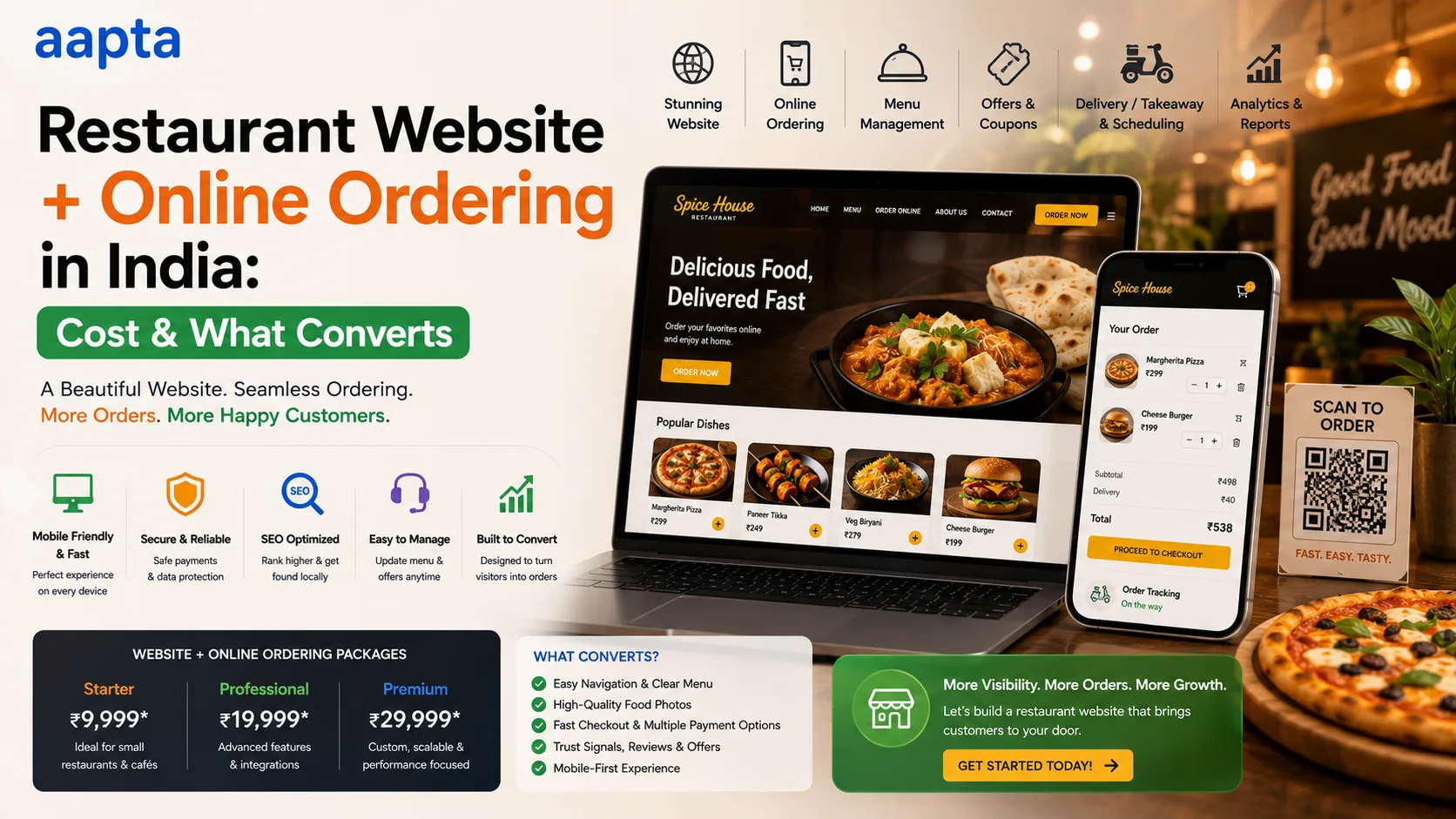
| Starter | ₹40,000 to ₹70,000 | Mobile-first site, digital menu, WhatsApp ordering, GMB + reviews, basic online ordering with UPI |
| Professional | ₹80,000 to ₹1,20,000 | Full cart + checkout, Razorpay/Cashfree, table reservations, offers/coupons, order updates, photo gallery |
| Premium | ₹1,50,000+ | Multi-outlet, loyalty programme, POS integration, custom app-like experience, delivery-zone logic |
Monthly running cost: an online-ordering system or POS in India starts around ₹1,000+ per month plus 1.5 to 2% transaction fees, and a full-featured setup runs ₹2,000 to ₹3,000 a month (orgnyz, 2026). Add payment-gateway fees (roughly 2% per transaction) and hosting (₹5,000 to ₹15,000 a year).
Put the two side by side and the logic is stark. A restaurant losing ₹1,50,000 a month to aggregator commissions can run its own ordering stack for ₹2,000 to ₹3,000 a month. Even if the website only recaptures a third of those orders, it pays for itself many times over within the first month.
Own website vs a platform vs staying aggregator-only
You have three realistic paths in 2026. Most successful restaurants use a blend.
| Approach | Effective cost | Own the customer? | Best for |
|---|---|---|---|
| Aggregators only (Swiggy/Zomato) | 25 to 35% per order | No | Pure discovery, new customers |
| Ordering platform (DotPe, Petpooja, UrbanPiper) | ₹1,000 to ₹3,000/mo + ~2% txn | Partly | Quick QR/UPI ordering, POS + aggregator sync |
| Your own website + ordering | Build once + ₹2,000 to ₹3,000/mo | Yes, fully | Repeat customers, brand control, best margins |
Platforms like Petpooja (which powers over 1,00,000 restaurants), DotPe (QR-and-UPI ordering), and UrbanPiper (middleware that syncs your POS with Swiggy and Zomato) are a fast way to get direct ordering live, and they integrate with your billing. The tradeoff is that you are still on their rails and their branding, and the customer relationship is only partly yours.
Your own website costs more to set up but gives you full ownership: your brand, your data, your margins, and no per-order platform cut beyond payment fees. For a restaurant with a base of regulars, this is where the real money is. The smartest setup often combines them: aggregators for discovery, your own site and a platform's ordering rails for the repeat business you convert off them.
What actually converts on a restaurant website
A restaurant site can have online ordering and still convert badly. Here is what moves diners from "browsing" to "order placed," in rough order of impact.
- Speed on mobile. If the menu takes more than two or three seconds to load on 4G, you have lost orders you never knew about. Fast, mobile-first pages are the foundation, which is why we treat speed optimisation as core, not cosmetic.
- Appetising photos. Real, well-lit photos of your actual dishes are the single biggest conversion lever in food. A text-only menu converts a fraction of what a photo menu does.
- A menu that is easy to order from. Categories, clear prices, quick add-to-cart, minimal taps to checkout. Every extra step loses a percentage of orders.
- UPI at checkout. India runs on UPI. A checkout that forces card entry instead of a UPI tap will leak orders. Offer UPI first.
- A WhatsApp option. Many diners want to order or confirm on WhatsApp. A one-tap WhatsApp ordering flow captures the customers who will never complete a web form.
- A reason to order direct. A small "10% off when you order from our website" beats the aggregator experience and trains regulars to come to you. Print the offer on your aggregator packaging so their customers become yours.
- Social proof. Google reviews and ratings visible on the site build the trust that converts a first-time visitor.
- Reservations for dine-in. Not every visitor wants delivery; capture the table-booking intent too.
The through-line: reduce friction and give people a reason to choose you directly. A fast, photo-rich, UPI-and-WhatsApp-ready site with a small direct-order incentive will steadily migrate your regulars off the 30% channel.
Restaurants are hyperlocal: the search and AI angle
Discovery still matters, and for restaurants it is overwhelmingly local. Two things to get right alongside the website:
- Google Business Profile is your highest-value asset after the website itself. Reviews, photos, hours, and the "order" link drive a huge share of restaurant discovery. Our Google Business Profile guide covers the full setup, and local maps SEO with and without a website explains how the two work together.
- "Best restaurant near me" is increasingly answered by AI. When someone asks ChatGPT or Gemini for a good place to eat nearby, you want to be in that answer. That is a different discipline from Google ranking, and I break it down in GEO for local businesses. For the wider industry picture, our overview of India's restaurant industry sets the context this all sits in.
If you also run paid promotion, sending those ads to your own ordering page rather than an aggregator listing keeps the margin and the data with you, a point I cover in Google Ads with vs without a website.
A realistic first 90 days
- Weeks 1 to 3: Build a Professional-tier site with your full menu, photos, online ordering, UPI + WhatsApp, and your Google Business Profile linked.
- Weeks 3 to 5: Add a direct-order incentive (a small discount for website orders), and start printing it on your aggregator packaging so their customers discover your direct channel.
- Weeks 5 to 8: Gather reviews, wire up order updates on WhatsApp, and set up a simple loyalty nudge for repeat orders.
- Weeks 8 to 12: Review which dishes and offers convert, and push your regulars toward direct ordering through WhatsApp broadcasts and on-packaging prompts.
By the end of the quarter you have a direct channel running in parallel to the aggregators, quietly clawing back the margin you were handing over on every repeat order.
Common mistakes restaurants make with their website and ordering
Building the site is the easy part. These are the errors that leave the direct channel underused, and how to avoid each.
- Hiding the menu behind a PDF. A downloadable PDF menu is not an ordering experience. The menu has to be a live, mobile-friendly, add-to-cart page, or diners bounce straight back to the aggregator.
- Giving people no reason to order direct. If your website offers the exact same price and experience as Swiggy, your regulars have no reason to switch. A small website-only discount, printed on your aggregator packaging, is what actually migrates them. Restaurants that push this consistently have reported saving ₹50,000 or more a month in commissions (DineOpen, 2026).
- Card-first checkout. Forcing card details when the customer wants to tap UPI is the fastest way to an abandoned cart in India. UPI goes first, always.
- Slow, image-heavy pages that choke on 4G. Appetising photos are essential, but unoptimised ones make the menu load slowly and cost you the order. Compress everything.
- Treating the website as the whole strategy. A thin Google Business Profile starves the discovery layer that feeds your site. The profile and the website work as a pair, not a substitute.
- Capturing phone numbers and never using them. Owning the channel only pays off if you act on it. A simple WhatsApp message to past customers about a weekend offer is direct revenue an aggregator would never hand you.
- Not tracking where orders come from. If you cannot see how many orders your website drives versus the aggregators, you cannot justify pushing harder on the direct channel. Basic order-source tracking turns a hunch into a decision.
The pattern is the same one that separates a busy kitchen from a profitable one: the aggregators optimise for their margin, not yours. Your own channel only pays off when you make it fast, cheaper for the customer to use, and actively promoted to the regulars who already love your food.
Frequently asked questions
How much does a restaurant website with online ordering cost in India?
A starter site with a digital menu, WhatsApp ordering, and basic UPI ordering runs ₹40,000 to ₹70,000; a professional site with full cart, checkout, reservations, and offers runs ₹80,000 to ₹1,20,000; a premium multi-outlet or loyalty build starts around ₹1,50,000. On top of the build, budget ₹2,000 to ₹3,000 a month for the ordering system plus roughly 2% payment-gateway fees and ₹5,000 to ₹15,000 a year for hosting. Against aggregator commissions of 25 to 35% per order, this pays for itself quickly.
How much do Swiggy and Zomato actually charge restaurants?
The base commission is 17 to 28%, but the effective deduction is 25 to 35% of order value once you add the per-order platform fee (around ₹17.58), 18% GST charged on the commission itself, and mandatory discounts. On a ₹500 order at 22% commission you keep about ₹370 before packaging and food cost. That is why moving even a portion of your repeat orders to your own website has such a large impact on margin.
Should I leave Swiggy and Zomato if I build my own website?
No. Aggregators are strong for discovery, reaching new customers who have never heard of you. The smart play is to stay on them for discovery while building your own ordering channel for repeat customers, then actively nudge your regulars to order direct with a small incentive. You keep the new-customer reach and stop paying 30% on the customers who already know you.
Is it better to build my own website or use a platform like DotPe or Petpooja?
Platforms like DotPe, Petpooja, and UrbanPiper get direct ordering live fast and integrate with your billing and POS, but you are still on their rails and the customer relationship is only partly yours. Your own website costs more upfront but gives you full ownership of the brand, the data, and the margin. Many restaurants use both: a platform's ordering rails plus their own branded site. For a restaurant with a real base of regulars, owning the channel is worth it.
What features make a restaurant website actually convert?
Speed on mobile, appetising photos of your real dishes, an easy-to-order menu with minimal checkout steps, UPI as the first payment option, a WhatsApp ordering option, visible Google reviews, and a reason to order direct such as a small website-only discount. Restaurants are mobile-first (79% of orders), so a fast, photo-rich, UPI-and-WhatsApp-ready experience is what turns browsers into orders.
Do restaurants need a Google Business Profile as well as a website?
Yes, and it may be your highest-value asset after the website itself. A huge share of restaurant discovery happens through Google Maps and local search, where your profile's reviews, photos, hours, and order link do the work. Set up your website and Google Business Profile together so the profile drives discovery and the website captures the direct order.
Will an AI chatbot or WhatsApp automation help my restaurant?
For most restaurants the highest-value automation is WhatsApp: order confirmations, updates, and a simple ordering flow where customers already are. A full AI chatbot is usually secondary to getting fast mobile ordering and WhatsApp right first. Start with the ordering experience and WhatsApp, then layer automation on once the direct channel has volume.
About the author
Dharmendra Asimi is the founder of Aapta Solutions, established in 2007 and now serving SMBs and growing brands across India, the United States, and the United Kingdom. Over the past twenty years he has shipped WordPress builds, e-commerce stores, managed cloud hosting, and SEO programmes for hundreds of businesses (from single-product Shopify stores to multi-region WordPress estates handling Black Friday peaks).
He is the creator of Aapta GEO (a free 30-second AI-readiness scan) and Aapta SEO AI (a monthly tracker for how ChatGPT, Claude, Perplexity, and Gemini cite your content). His writing on web engineering and AI-search visibility is read by founders, marketing teams, and SEO managers across three time zones.
Areas of expertise: WordPress development at scale · managed cloud hosting (AWS, GCP, Azure, Cloudflare) · technical SEO · Generative Engine Optimization (GEO) · AI-search citation tracking · ecommerce architecture across WooCommerce, SureCart, Shopify, and Magento · Site Reliability Engineering for content platforms · brand strategy and visual identity.
Connect: LinkedIn · X · Instagram · personal site · About page · Contact Aapta
This article is maintained as part of Aapta's content quality programme. If any data point looks stale or incorrect next time you read this, tell us and we will verify and update within 48 hours.
Need help with this?
Our team has 19+ years of experience and can help you implement everything discussed in this article.
Book a Discovery Call